
How Automated Cloud Audits Solve Modern Cybersecurity Challenges
+
Table of Contents
- 1 Navigating Evolving Cybersecurity Challenges in Cloud Environments
- 1.1 Shifting Landscape: Modern Threats Targeting Cloud Infrastructures
- 1.2 Why Traditional Security Audits Fall Short in the Cloud
- 2 Cloud Security Automation: A Game-Changer for Cyber Risk Reduction
- 2.1 Automated Cloud Audits Versus Manual Methods: Efficiency at Scale
- 2.2 Real-Time Threat Detection and Rapid Response: Stopping Attacks Before They Grow
- 2.3 Mastering Compliance with Automated Cloud Audit Solutions
- 2.4 Streamlining Industry Frameworks and Regulatory Requirements
- 2.5 Continuous Risk Assessment & Gap Analysis
- 3 Essential Features: What to Look for in Top Cloud Security Audit Tools
- 3.1 Core Capabilities of Leading Audit Platforms
- 3.2 Integrations That Matter: Security Automation Across Your Stack
- 3.3 Next-Gen Best Practices for Automated and Secure Cloud Deployments
- 3.4 Proactive Approaches for Mitigating Emerging Cloud Threats
- 3.5 Continuous Improvement with Managed Cloud Pentesting Services
- 3.6 Getting Started: A Practical Roadmap for Implementing Automated Cloud Audits
- 3.7 Readiness Assessment & Roadmap Creation
- 3.8 Pilot to Full Rollout: Measuring, Reporting, and Optimizing
- 3.9 Staying Ahead: Why Automated Cloud Audits Are Your Strongest Security Move
- 3.10 Your Cloud Security Questions, Answered
Cloud breaches don’t just drain budgets; they shatter the trust you’ve spent years building. In 2024, the average cost of a single data breach climbed past $4.8 million, and a striking share of those incidents traced directly back to cloud misconfigurations and poor visibility. If your organization runs across multiple cloud environments, you’re juggling dozens of services, shifting permissions, and evolving policies often simultaneously. Manual checks simply can’t keep up with that pace anymore. Automated cloud audits hand security teams the continuous, scalable oversight they need to stay genuinely ahead, not scrambling to catch up after damage is done.
Navigating Evolving Cybersecurity Challenges in Cloud Environments
Here’s the uncomfortable truth: modern cloud environments move fast, and the threats targeting them have evolved to match that exact speed. Before implementing any defense strategy, it’s important to understand the factors driving the risk.
Most organizations today blend automation with skilled human validation because neither alone tells the complete story. To genuinely stress-test cloud environments and surface the hidden weaknesses that automated scans might sail right past, many security teams lean on managed cloud pentesting services for secure deployments. That combination of machine efficiency and expert human judgment? It’s what actually moves the needle.
Shifting Landscape: Modern Threats Targeting Cloud Infrastructures
Misconfiguration remains the single most exploited entry point in cloud breaches, full stop. Attackers layer on lateral movement, compromised service accounts, and supply chain vulnerabilities to gain and expand their footholds. According to Tenable’s 2024 Cloud Risk Report, 38% of organizations have at least one cloud workload that is critically vulnerable, highly privileged, and publicly exposed. That’s not some rare outlier scenario; it’s a widespread, documented reality.
Social engineering targeting cloud credentials has also grown sharper. Phishing campaigns now specifically harvest cloud console logins, bypassing perimeter defenses entirely. No firewall catches a stolen password.
Why Traditional Security Audits Fall Short in the Cloud
Manual audits are point-in-time exercises. By the time the report lands in your inbox, your cloud environment has already changed, sometimes dramatically. Compliance drift, where configurations gradually slip out of alignment, happens silently between those audit cycles.
The cybersecurity challenges in cloud environments are fundamentally about speed and scale. Manual processes can’t keep pace with infrastructure that spins up, scales, and reconfigures itself in minutes. That’s not a criticism of your team; it’s just physics.
Cloud Security Automation: A Game-Changer for Cyber Risk Reduction
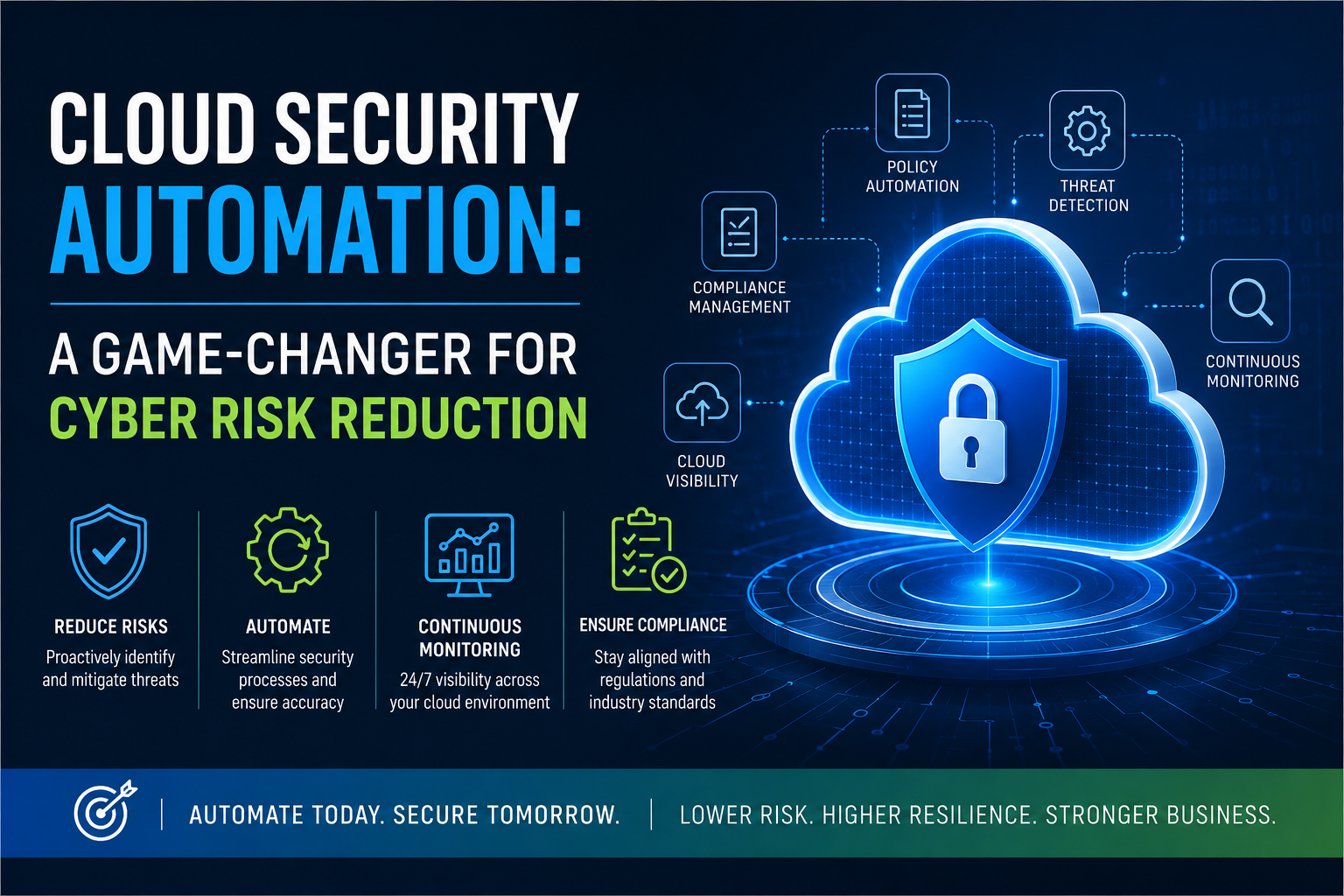
Given that manual audits are clearly struggling to match today’s cloud complexity, the case for automation isn’t theoretical anymore. Organizations adopting cloud security automation are pulling decisively ahead of those still relying on scheduled reviews and spreadsheets.
Automated Cloud Audits Versus Manual Methods: Efficiency at Scale
Manual audits might cover a snapshot of your environment across several days of effort. Automated audits run continuously, scanning every asset, permission, and configuration in real time. The efficiency gap is enormous, as automated systems assess thousands of resources in the time a human team reviews dozens.
Automated scanning and policy-as-code can prevent up to 75% of misconfigurations before deployment. That’s not a marginal improvement. This represents a fundamental change in the way security is implemented throughout the organization.
Real-Time Threat Detection and Rapid Response: Stopping Attacks Before They Grow
Automation delivers value beyond efficiency by responding instantly when threats arise. It can identify privilege escalations, exposed storage resources, and suspicious API activity within seconds. That detection speed is precisely what stops a misconfiguration from snowballing into a full breach.
Cloud security audit tools integrated with incident response workflows let your teams act on findings immediately, not after the next scheduled review cycle rolls around.
Mastering Compliance with Automated Cloud Audit Solutions
Stopping active threats is only half the battle. Maintaining continuous compliance with regulatory requirements in the cloud is just as important—and often just as challenging.
Streamlining Industry Frameworks and Regulatory Requirements
Frameworks like SOC 2, ISO 27001, HIPAA, GDPR, and PCI DSS each carry specific control requirements your cloud environments must satisfy. Manually mapping configurations to each framework is both time-consuming and error-prone, the kind of tedious work where mistakes hide easily. Cloud compliance solutions automate this mapping entirely, flagging drift the moment it occurs rather than surfacing it during an annual audit review.
This approach prevents the accidental noncompliance that happens when teams move fast without checking every policy implication. And in regulated industries, accidental noncompliance carries real consequences.
Continuous Risk Assessment & Gap Analysis
Framework mapping is a solid foundation. But maintaining that posture over time demands something more proactive than a quarterly checklist. Continuous cloud compliance solutions use automated alerting to surface gaps before regulators or attackers find them first. Automatically generated audit trails also make regulator engagements significantly smoother. Less scrambling, more confidence.
Cloud security audit tools featuring gap analysis dashboards give your security team a real-time picture of exactly where you stand against every applicable control.
Essential Features: What to Look for in Top Cloud Security Audit Tools
Knowing what automated compliance management can accomplish is one thing. Knowing what to actually demand from a platform before signing a contract is another.
Core Capabilities of Leading Audit Platforms
Strong cloud security audit tools should include AI-driven configuration reviews, vulnerability detection, and risk prioritization. Multi-cloud and hybrid environment support is non-negotiable; most organizations aren’t running a single cloud provider. Automated reporting, dashboard analytics, and API-first interfaces round out what a mature, enterprise-ready platform needs to deliver.
| Feature | Manual Audit | Automated Audit Tool |
| Coverage Frequency | Periodic | Continuous |
| Misconfiguration Detection | Reactive | Proactive |
| Compliance Mapping | Manual | Automated |
| Remediation Speed | Days/Weeks | Minutes |
| Multi-Cloud Support | Limited | Native |
Integrations That Matter: Security Automation Across Your Stack
Powerful standalone features are only as effective as their ability to communicate with your broader security ecosystem. SIEM and SOAR integrations let audit findings feed directly into incident response workflows. DevSecOps pipeline integrations enforce security gates before deployment ever happens. Identity and access management connections automatically surface over-privileged accounts, often before anyone realizes those accounts exist.
Next-Gen Best Practices for Automated and Secure Cloud Deployments
Understanding what top-tier tools offer is valuable. But deploying them using practices that eliminate the conditions threats need to flourish, that’s where the real security gains lie.
Proactive Approaches for Mitigating Emerging Cloud Threats
Zero-trust architecture, automated remediation workflows, and privilege minimization form the three pillars of a proactive cloud security posture. Don’t wait for alerts to trigger before acting. Build systems that enforce least-privilege access by default and auto-remediate common misconfigurations without requiring human intervention every single time.
Continuous Improvement with Managed Cloud Pentesting Services
Automated defenses grow exponentially stronger when stress-tested against real-world attack scenarios. Pairing ongoing automated audits with regular expert-led testing creates a layered defense that catches what either method would miss alone.
Getting Started: A Practical Roadmap for Implementing Automated Cloud Audits
Let’s make this concrete. Here’s how you actually translate everything above into a roadmap your organization can begin executing today.
Readiness Assessment & Roadmap Creation
Start by inventorying your cloud assets, every workload, account, and integration in scope. Prioritize assets carrying the most sensitive data or the highest privilege levels. Choose tools aligned with your specific compliance requirements and multi-cloud footprint. Train your team not just on tool operation, but on interpreting findings and acting on them decisively.
Pilot to Full Rollout: Measuring, Reporting, and Optimizing
Once your groundwork is solid, scale intelligently. Track KPIs like mean time to detect, misconfiguration resolution rate, and compliance drift frequency. Build feedback loops so findings from each audit cycle actively sharpen the next one. Security isn’t a one-time project; it compounds.
Also Read- Droven io Cybersecurity Updates: 2026 Comprehensive Guide
Staying Ahead: Why Automated Cloud Audits Are Your Strongest Security Move
Cloud security is an ongoing practice, not a box to check. Automated cloud audits remove the visibility gaps often missed by manual assessments, providing continuous insight into every aspect of your cloud environment. Layer that with cloud security automation, strong cloud compliance solutions, and expert validation, and you’ve built a defense posture that genuinely scales alongside your business.
The organizations pulling ahead right now aren’t waiting for the next breach to motivate action. Start evaluating your current audit approach today because the gaps are almost certainly already there.
Your Cloud Security Questions, Answered
-
What challenges do automated cloud audits solve compared to manual audits?
Automated audits provide continuous coverage, catching misconfigurations and compliance drift in real time. Manual audits are periodic and can’t keep pace with cloud environments that change constantly, leaving gaps between review cycles.
-
Why is auditing important in cybersecurity?
A cybersecurity audit comprehensively assesses an organization’s security posture and cyber risks. It proactively identifies vulnerabilities and threats, giving teams actionable mitigation options before weaknesses get exploited by attackers.
-
How does cloud computing affect cybersecurity?
Leading cloud providers implement strong measures like encryption, firewalls, and multi-factor authentication. Cloud computing also ensures data backup and recovery, reducing data loss risk from system failures or cyberattacks significantly.