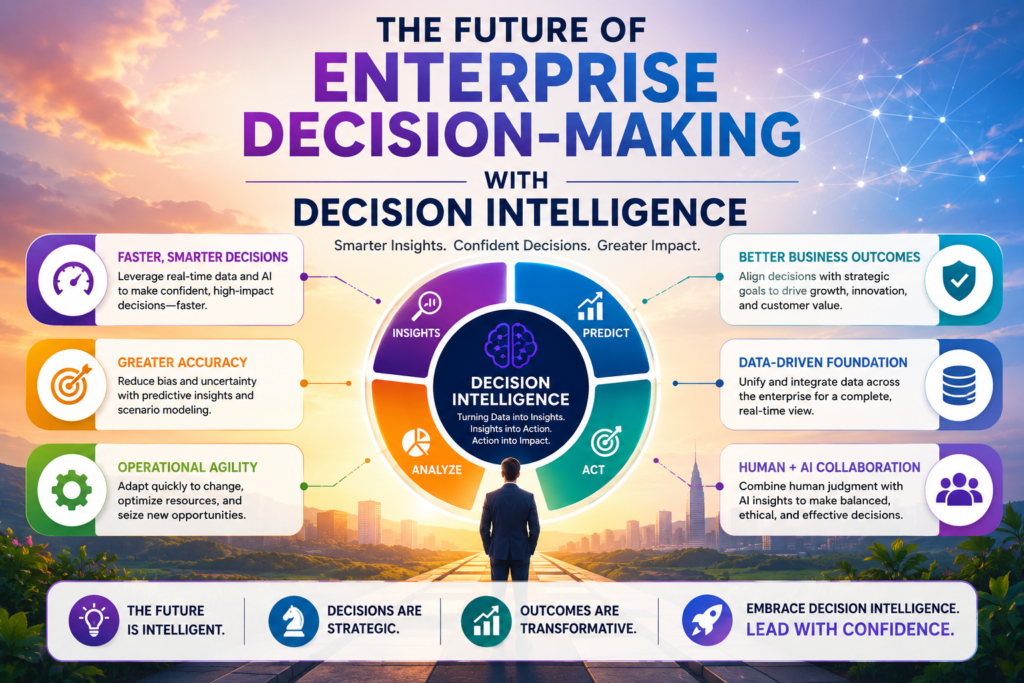
The Future of Enterprise Decision-Making with Decision Intelligence
+
Table of Contents
- 1 Understanding Decision Intelligence
- 2 Benefits of Decision Intelligence for Enterprises
- 2.1 Faster Decision-Making
- 2.2 Improved Accuracy
- 2.3 Enhanced Operational Efficiency
- 2.4 Better Risk Management
- 2.5 Increased Business Agility
- 2.6 Enterprise Use Cases for Decision Intelligence
- 2.7 Supply Chain Management
- 2.8 Finance and Operations
- 2.9 Customer Experience
- 2.10 Manufacturing
- 2.11 Procurement
- 2.12 The Future of Enterprise Decision-Making
- 2.13 How Aera Technology Supports Decision Intelligence
- 3 Final Thoughts
In today’s fast-paced digital economy, organizations face increasing pressure to make faster, smarter, and more accurate decisions. Traditional decision-making processes often rely on fragmented data, manual analysis, and delayed actions, making it difficult for businesses to keep up with changing market conditions. This is where Decision Intelligence is reshaping the future of enterprise decision-making.
By combining artificial intelligence (AI), machine learning, data analytics, and automation, Decision Intelligence enables organizations to transform data into actionable insights and make decisions with greater speed and confidence. As businesses continue to embrace digital transformation, Decision Intelligence is becoming a critical capability for improving operational efficiency, reducing risks, and driving sustainable growth.
Understanding Decision Intelligence
Decision Intelligence is an advanced approach that connects data, insights, and actions to optimize business decisions. Unlike traditional analytics, which primarily focuses on reporting and visualization, Decision Intelligence goes a step further by recommending and automating actions based on real-time data and business objectives.
Organizations generate vast amounts of data from various sources, including supply chains, customer interactions, financial systems, and operational processes. Decision Intelligence helps enterprises analyze this information, identify patterns, predict outcomes, and take the most effective course of action.
The goal is not simply to provide information but to enable intelligent decision-making that improves business performance across the enterprise.
Why Traditional Decision-Making Is No Longer Enough
Many organizations still rely on manual decision-making processes that can be slow, inconsistent, and prone to human error. Decision-makers often spend valuable time gathering data, analyzing reports, and evaluating multiple scenarios before taking action.
Several challenges commonly affect traditional decision-making:
- Data silos that limit visibility across departments
- Delayed access to critical business insights
- Inconsistent decision-making processes
- Increased operational risks
- Difficulty responding to rapidly changing market conditions
As businesses become more complex, these limitations can significantly impact productivity, profitability, and competitiveness.
Decision Intelligence addresses these challenges by providing real-time visibility, predictive insights, and automated recommendations that support better business outcomes.
The Role of AI in Decision Intelligence
Artificial intelligence is a key driver behind modern Decision Intelligence platforms. AI technologies can process massive amounts of structured and unstructured data far faster than human teams.
By leveraging machine learning algorithms, organizations can:
- Predict future business outcomes
- Identify hidden patterns and trends
- Detect anomalies and risks
- Optimize resource allocation
- Improve operational planning
AI-powered Decision Intelligence systems continuously learn from new data, enabling businesses to refine their decision-making processes over time. This creates a dynamic and adaptive approach to enterprise management that supports continuous improvement.
Benefits of Decision Intelligence for Enterprises
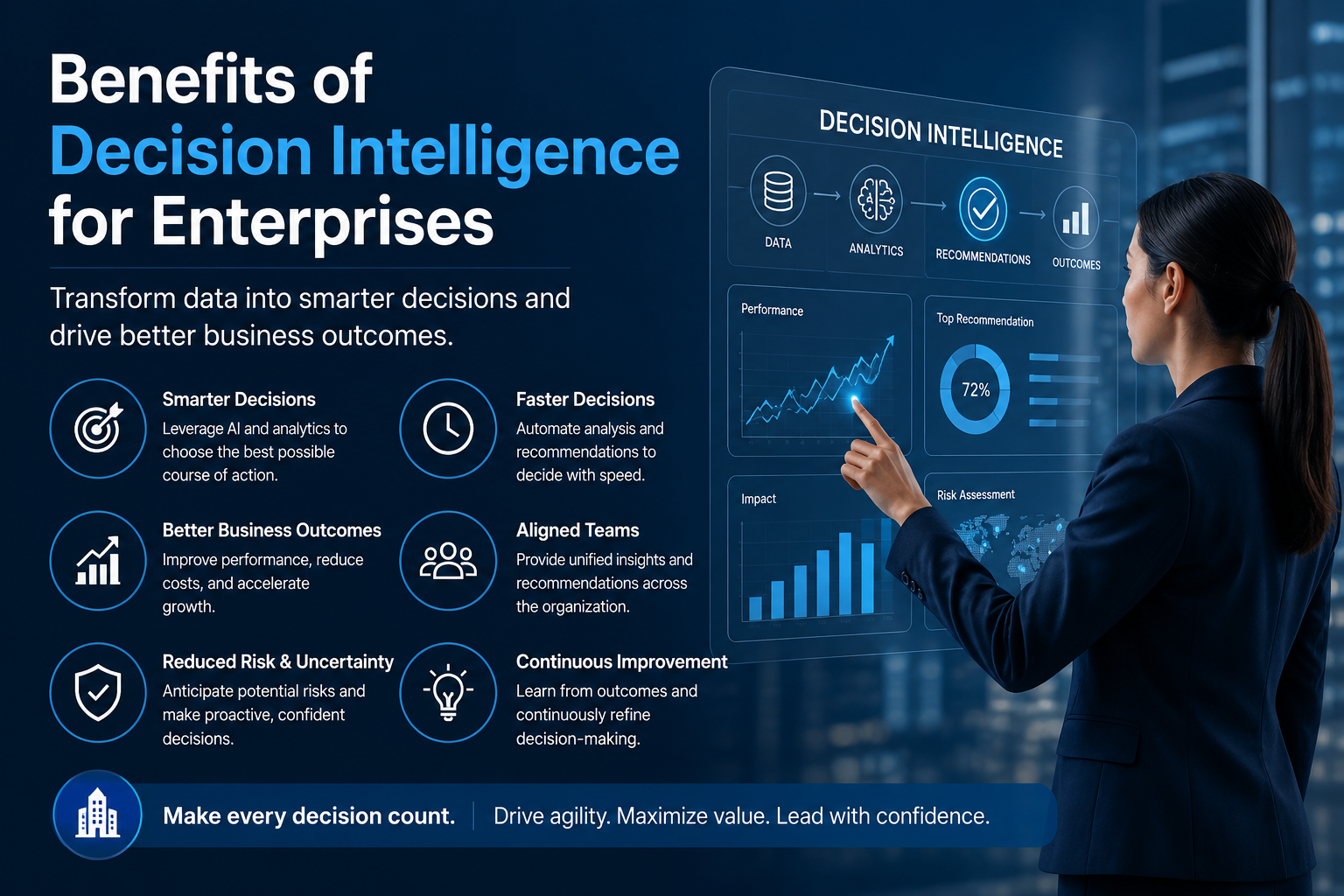
As organizations seek to become more agile and data-driven, Decision Intelligence offers several important benefits.
Faster Decision-Making
Real-time data analysis allows enterprises to make informed decisions quickly. Instead of waiting for reports or manual reviews, decision-makers can act immediately based on current business conditions.
Improved Accuracy
Decision Intelligence reduces reliance on assumptions and guesswork by providing data-driven recommendations supported by advanced analytics and AI models.
Enhanced Operational Efficiency
Automation streamlines repetitive tasks and minimizes manual intervention, helping organizations improve productivity and reduce costs.
Better Risk Management
Predictive capabilities help businesses identify potential disruptions before they occur, allowing teams to proactively address risks and minimize negative impacts.
Increased Business Agility
Organizations can respond more effectively to changing customer demands, supply chain disruptions, and market opportunities by leveraging real-time insights and intelligent recommendations.
Enterprise Use Cases for Decision Intelligence
Decision Intelligence can deliver value across multiple business functions and industries.
Supply Chain Management
Organizations can optimize inventory levels, improve demand forecasting, reduce shortages, and enhance supplier collaboration through intelligent decision-making.
Finance and Operations
Finance teams can improve budgeting, forecasting, cash flow management, and financial planning with AI-driven insights and recommendations.
Customer Experience
Businesses can personalize customer interactions, improve service quality, and identify opportunities to increase customer satisfaction and loyalty.
Manufacturing
Manufacturers can use Decision Intelligence to optimize production schedules, reduce downtime, improve quality control, and enhance operational performance.
Procurement
Procurement teams can make smarter sourcing decisions, manage supplier risks, and improve purchasing efficiency using data-driven recommendations.
Also Read- Best Mobile App Development Companies in 2026 for AI-Powered Solutions
The Future of Enterprise Decision-Making
The future of enterprise decision-making will increasingly rely on intelligent systems that combine human expertise with AI-powered insights. As organizations continue to adopt advanced technologies, Decision Intelligence will play a central role in enabling autonomous and semi-autonomous decision-making processes.
Future Decision Intelligence platforms will provide greater visibility across enterprise operations, continuously monitor business performance, and proactively recommend actions before issues arise. This shift will help organizations move from reactive decision-making to proactive and predictive decision-making.
Businesses that embrace Decision Intelligence today will be better positioned to navigate uncertainty, seize opportunities, and maintain a competitive advantage in the years ahead.
How Aera Technology Supports Decision Intelligence
Aera Technology is helping organizations unlock the full potential of Decision Intelligence through innovative solutions that connect data, intelligence, and automation. By enabling enterprises to make faster and more informed decisions, Aera Technology empowers businesses to improve operational performance and drive measurable outcomes.
As enterprise environments become increasingly complex, organizations need intelligent systems capable of transforming data into action. Decision Intelligence provides the foundation for this transformation, helping businesses make smarter decisions at scale.
Final Thoughts
Decision Intelligence is rapidly becoming the future of enterprise decision-making. By integrating AI, analytics, automation, and real-time data, organizations can improve decision quality, increase agility, and drive better business outcomes.
As companies continue their digital transformation journeys, Decision Intelligence will serve as a critical competitive advantage. With solutions from Aera Technology, enterprises can move beyond traditional decision-making models and embrace a more intelligent, efficient, and data-driven future.