Construction Industry ERP Software Built For Real Contractor Workflows
+
Table of Contents
- 1 What ERP Software Means For Construction Companies
- 1.1 Why Disconnected Systems Create Bigger Problems As You Grow
- 1.1.1 Common problems include:
- 1.2 Core ERP Software Features Contractors Should Look For
- 1.3 How ERP Software Improves Cost Control
- 1.4 Why Cloud-Based ERP Fits Construction Teams
- 2 Building A More Connected ERP Software Strategy
Construction companies do not struggle because their teams are lazy or careless. Most contractors are already working hard. Project managers are chasing updates, accounting is cleaning up the numbers, field crews are sending information however they can, and leadership is trying to make decisions based on reports that may already be behind.
The real issue is usually the system underneath the work. As contractors grow, spreadsheets, disconnected accounting tools, emails, shared drives, and manual reports begin to create friction. The business may still be moving, but the information is not moving cleanly with it. That is where construction industry ERP software becomes more than a technology upgrade. It becomes the operating foundation that connects the field, office, and financial side of the company.
What ERP Software Means For Construction Companies
ERP stands for enterprise resource planning, but contractors do not need a complicated definition. In plain terms, ERP brings the core parts of the business into one connected system. For a construction company, that can include project accounting, job costing, procurement, billing, change orders, labor tracking, vendor management, document control, approvals, reporting, and financial forecasting.
The value is not just having more features. The value is that it gives every team a cleaner source of information. A project manager can see job cost movement. Accounting can see how project activity affects billing and financial reporting. Leadership can review performance across active jobs without waiting for someone to rebuild a spreadsheet.
Construction work changes fast. A material delay, labor overrun, missed change order, or late invoice can quickly affect margin and cash flow. ERP helps contractors see those changes sooner so they can make better decisions before a small issue becomes expensive.
Why Disconnected Systems Create Bigger Problems As You Grow
Many contractors start with simple tools because they make sense at the time. A spreadsheet tracks job costs. QuickBooks handles accounting. Email manages approvals. A shared folder holds project documents. A project manager keeps notes in whatever format works best. At a small scale, that can feel manageable.
Growth changes the picture. More jobs mean more cost codes, vendors, subcontractors, approvals, invoices, schedules, and reporting needs. Once a business has too many moving parts, disconnected systems start to slow everyone down. Teams spend too much time searching for information, checking which version is current, and reconciling numbers that should have matched from the start.
Common problems include:
- Job cost reports arrive too late to help project managers adjust.
- Accounting and operations work with different numbers.
- Change orders get approved but do not reach billing fast enough.
- Leadership waits for manual reports to understand margin and cash flow.
- Field updates are scattered across texts, emails, apps, and paper notes.
- Teams enter the same information more than once.
That kind of friction costs more than admin time. It affects margin, decision-making, billing speed, customer trust, and the company’s ability to scale without adding chaos.
Core ERP Software Features Contractors Should Look For
Not every ERP platform fits construction. Contractors need software that understands how jobs are estimated, purchased, built, billed, and reported. A generic system may handle financials, but construction requires deeper project controls and tighter field-to-office visibility.
A strong ERP setup should support:
- Real-time job costing.
- Project accounting.
- Budget tracking.
- Change order management.
- Procurement and vendor workflows.
- Labor and time tracking.
- Progress billing and retainage.
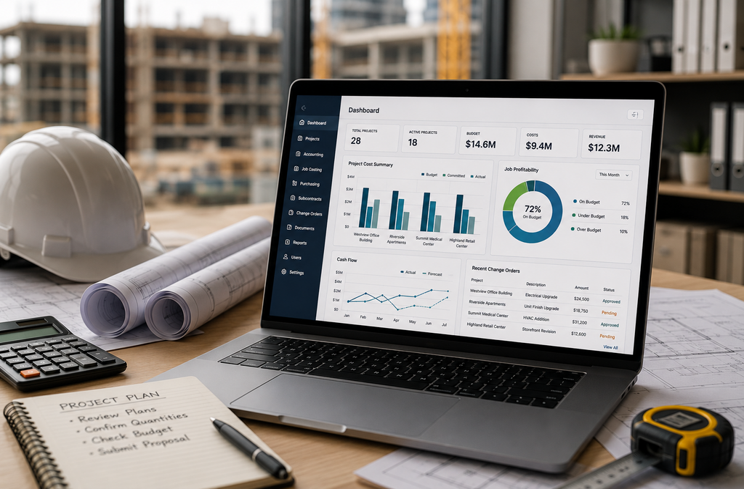
- Dashboards and reporting.
- Document management.
- Workflow approvals.
- Field data capture.
- Multi-project visibility.
How ERP Software Improves Cost Control
Cost control is not about cutting corners. It is about giving teams the information they need to protect the margin. Construction costs fluctuate constantly, and contractors need visibility before the job is financially damaged.
ERP supports cost control by helping teams spot budget variances sooner. If labor is trending above the estimate, project managers need to know quickly. If material commitments are pushing a job over budget, purchasing and operations need visibility. If approved work has not been billed, accounting needs to catch it before cash flow tightens.
Better cost control can come from:
- Cleaner purchase order tracking.
- Faster budget variance alerts.
- More accurate labor and material visibility.
- Stronger change order control.
- Connected billing workflows.
- Better forecasting across active projects.
- Less duplicate entry and manual cleanup.
The biggest advantage is timing. Reports are only useful if they arrive while action is still possible. ERP gives contractors a better chance to adjust during the job rather than explain losses after the fact.
Also Read- Lenovo Yoga Book 9i Review: The Most Beautiful Laptop I’d Hesitate to Recommend
Why Cloud-Based ERP Fits Construction Teams
Construction does not happen in one office. It happens across job sites, trailers, warehouses, vendor locations, client meetings, and remote teams. Cloud-based ERP fits that reality because it gives the right people access to the right information from wherever work is happening.
That does not mean every user sees everything. Permissions still matter. Field teams may only need simple update workflows. Project managers may need job cost dashboards, approvals, and documentation. Accounting may need billing, financial reporting, and cost details. Executives may need reporting on margin, backlog, cash flow, and project health.
The point is alignment. When data moves from the field to the office more quickly, the business runs with less lag. A superintendent can submit an update. A project manager can review the operational impact. Accounting can see whether billing or documentation is affected. Leadership can review job performance without having to chase five people for context.
Building A More Connected ERP Software Strategy
Construction companies need systems that can keep up with the way jobs actually move. Project work, accounting, billing, purchasing, reporting, field updates, and leadership visibility all depend on the same information. When those pieces are disconnected, the business loses time and control. When they work together, contractors can manage growth with more confidence.
If your company is tired of chasing spreadsheets, waiting on reports, or making decisions without a clear view of project performance, it may be time to rethink your ERP approach. A stronger ERP strategy can help create cleaner data, better processes, and sharper visibility across the business.