The Psychology of Online Scams: Why People Fall for Them
+
Table of Contents
- 1 What’s Really Driving Digital Deception
- 2 Why Normal People Get Scammed
- 2.1 Cognitive Biases That Open the Door
- 2.2 How Emotional State Shapes Decision-Making
- 2.3 The False Security of Polished Presentation
- 3 Social Engineering: Manipulation Made Systematic
- 3.1 Spear Phishing and Manufactured Urgency
- 3.2 What Scammers Are Actually Targeting
- 3.3 AI and Deepfakes Are Already Here
- 4 Recognizing the Warning Signs Before It’s Too Late
- 5 Building Habits That Actually Protect You
- 6 What Behavioral Science Tells Us About Scam Prevention
- 7 Staying Ahead Requires More Than Good Intentions
Every day, thousands of people get deceived by scammers, and not because they were careless or uninformed. Scammers are genuinely skilled operators who understand how the human mind works, sometimes better than we understand it ourselves.
The field of online scam psychology surfaces some uncomfortable truths about our mental blind spots. According to a 2024 Consumer Reports survey, one in five American adults who encountered online scams ended up losing money to one. Understanding why people fall for scams isn’t purely academic; it’s among the most practically useful things you can do right now.
What’s Really Driving Digital Deception
Modern scams run far deeper than a poorly worded email asking for your banking details. Today’s fraudsters blend technology with behavioral psychology in ways that are genuinely difficult to detect, even for experienced users.
How Online Scams Have Evolved
The landscape has shifted dramatically. Clunky phishing emails gave way to AI-generated voices, deepfake video calls, and hyper-personalized messages that feel disturbingly authentic. Technology handed scammers a significant advantage. They can now clone a person’s voice from a short audio clip or build fake profiles that appear completely credible across multiple platforms.
Integrating a scam detection tool into your daily digital routine provides a critical layer of protection, flagging suspicious links, questionable messages, and unusual QR codes before impulsive action turns into a costly mistake.
Psychological Triggers Scammers Exploit
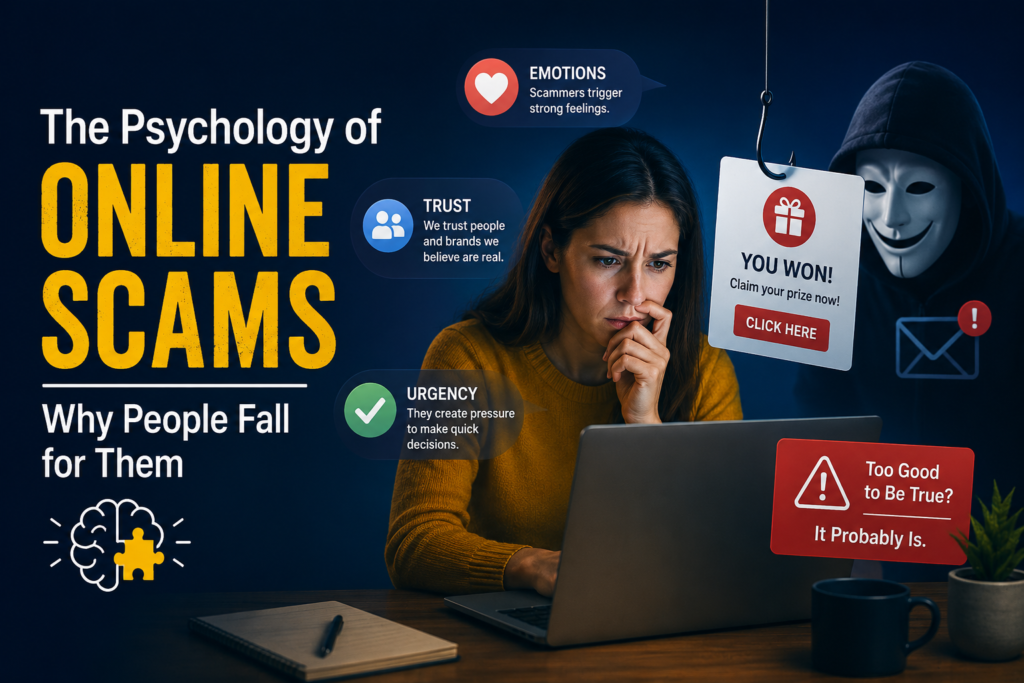
Here’s the thing: scammers aren’t just technically savvy. They’re emotionally strategic. Fear, urgency, and curiosity are their primary weapons, deployed with calculated timing.
When someone believes their bank account is about to be suspended, rational thinking immediately exits the room. That’s the whole point. Authority bias, manufactured scarcity, and social proof “thousands of others have already done this ” stack together to push victims past hesitation and toward action faster than they can consciously evaluate what’s happening.
Understanding how scams are built is only half the picture. The more unsettling reality is that entirely normal cognitive patterns make some of us significantly easier to deceive than we’d ever want to admit.
Why Normal People Get Scammed
Nobody enjoys entertaining the idea that they’re vulnerable. But the reasons people get scammed trace directly back to ordinary human psychology, not gullibility or carelessness.
Cognitive Biases That Open the Door
Anchoring bias causes people to accept the first piece of information they receive as the reference frame for everything that follows. Confirmation bias leads us to trust messages that resemble what we already expect, like an email that mirrors communications from our bank.
Optimism bias is perhaps the most dangerous of all. Most people genuinely believe they’re too sharp to fall for a scam. That confidence lowers their guard precisely when it should be highest. Scammers understand this perfectly and design schemes that feel just routine enough to bypass overconfidence without triggering suspicion.
How Emotional State Shapes Decision-Making
Stress, loneliness, and impulsivity create openings that experienced fraudsters actively seek out. Someone navigating financial hardship is considerably more susceptible to a “limited-time investment opportunity” than someone who feels economically stable.
FOMO, fear of missing out, functions as a powerful lever. When a message signals that a deal expires in minutes, it activates the part of the brain that prioritizes speed over scrutiny. That’s not a character flaw. That’s basic neuroscience being weaponized deliberately.
The False Security of Polished Presentation
There’s a persistent assumption that if something looks professional and well-designed, it must be legitimate. Scammers exploit this entirely. Slick websites, official-sounding language, and convincing brand visuals create a false sense of safety that neutralizes normal skepticism before it can engage.
People also extend unearned trust to familiar platforms. A scam delivered through a messaging app you already use carries a credibility boost that makes it exponentially more dangerous.
Social Engineering: Manipulation Made Systematic
Social engineering is the practice of manipulating people into willingly surrendering information or money. It’s not about hacking systems; it’s about hacking people.
Spear Phishing and Manufactured Urgency
Spear phishing targets specific individuals using personal details harvested from social media or data breaches. These attacks feel personal because they are. Scammers reference real names, employers, or recent purchases to establish credibility quickly.
Fake urgency almost always accompanies this approach. “Your account will be locked within 24 hours” is a classic example of pressure engineered to ensure victims act before they think.
What Scammers Are Actually Targeting
Romance scams, fraudulent investment platforms, and authority impersonation all share one thread: they exploit what people want most: connection, financial security, or validation. BBB Scam Tracker data shows online scams increased from 56.5% in 2022 to 68.4% in 2023, confirming that digital exploitation is accelerating at a troubling pace.
AI and Deepfakes Are Already Here
AI has made scams terrifyingly convincing. Voice cloning can replicate a family member’s voice with minimal source material. Deepfake video calls have been used to impersonate corporate executives and trick employees into authorizing large fund transfers. These aren’t hypothetical future threats; they’re active, documented incidents occurring right now.
Recognizing the Warning Signs Before It’s Too Late
Spotting a scam in real time requires training your instincts to slow down precisely when pressure is pushing you to speed up.
Red Flags Most People Miss
Unusual urgency, requests for unconventional payment methods, and narratives that shift slightly under follow-up questions are all signals worth pausing on. If someone is actively discouraging you from verifying their identity independently, that resistance is itself a warning sign.
Scammers circumvent natural vigilance by making contact feel expected. A message that appears to continue an established relationship lowers the suspicion that a cold approach would naturally trigger.
Why a Scam Detection Tool Matters More Than Instinct Alone
Human judgment, even well-trained judgment, often isn’t sufficient against today’s sophisticated schemes. Supplementing your own instincts with a reliable scam detection tool provides meaningful backup. These tools are built to analyze language patterns, behavioral cues, and suspicious links, frequently catching manipulation tactics that slip past even cautious, attentive users.
Building Habits That Actually Protect You
Real digital protection isn’t a single action. It’s a set of compounding habits that collectively make you a harder target.
Skepticism isn’t paranoia; it’s a trainable skill. Practicing critical evaluation during low-stakes digital interactions builds the mental muscle to apply the same scrutiny under real pressure. Multi-factor authentication, strong unique passwords, and tightened privacy settings all meaningfully reduce exposure. Unglamorous? Yes. Genuinely effective? Absolutely.
Sharing scam experiences also matters more than people realize. Platforms like the FTC’s ReportFraud.ftc.gov allow individuals to report incidents and warn others in the community. When one person catches a scam and reports it, the next potential victim gets a warning they wouldn’t otherwise have.
What Behavioral Science Tells Us About Scam Prevention
The psychology of online scams is a legitimate and growing area of behavioral research, not just practical cybersecurity advice.
Scammers essentially hijack the brain’s reward system. When someone believes they’re about to receive money, dopamine is released, and that neurological response actively suppresses caution. Urgency and novelty focus the victim’s attention on the anticipated reward rather than the underlying risk, making scrutiny feel irrelevant in the moment.
Researchers are now developing AI-based behavioral models capable of detecting manipulation patterns in real-time communications. These systems don’t merely scan for known scam templates; they identify the psychological architecture of a manipulative message, making them increasingly effective against novel, previously unseen attacks.
Common Questions About Online Scam Psychology
What is the psychological profile of a scammer?
Scammers manipulate emotions like fear, urgency, and trust with calculated precision. They exploit cognitive vulnerabilities and social norms to make deceptive requests feel reasonable, relying on emotional pressure rather than technical force.
Which demographics are most frequently targeted?
Older adults and those less familiar with evolving digital platforms are frequently targeted. However, younger adults are increasingly vulnerable, particularly through investment and romance scams. Emotional state and digital literacy tend to matter more than age alone.
Are certain personality traits linked to scam susceptibility?
Yes. High levels of trust, agreeableness, and a genuine desire to help others can increase susceptibility. People who score low on skepticism or who strongly value social harmony may find it harder to reject a manipulative request, even when something feels slightly off.
Staying Ahead Requires More Than Good Intentions
The psychology of online scams is worth more than a passing read; it’s knowledge that can genuinely shield you from real financial and emotional harm. The reasons people get scammed aren’t rooted in weakness or ignorance. They’re rooted in the entirely normal ways human brains process information under pressure.
Scammers exploit that with precision. By understanding how these schemes are architected and honestly recognizing your own cognitive and emotional vulnerabilities, you’re already building a meaningful defense. Use every tool available to you, stay constructively skeptical, and share what you learn because awareness, applied at scale, remains one of the most powerful countermeasures against digital fraud.