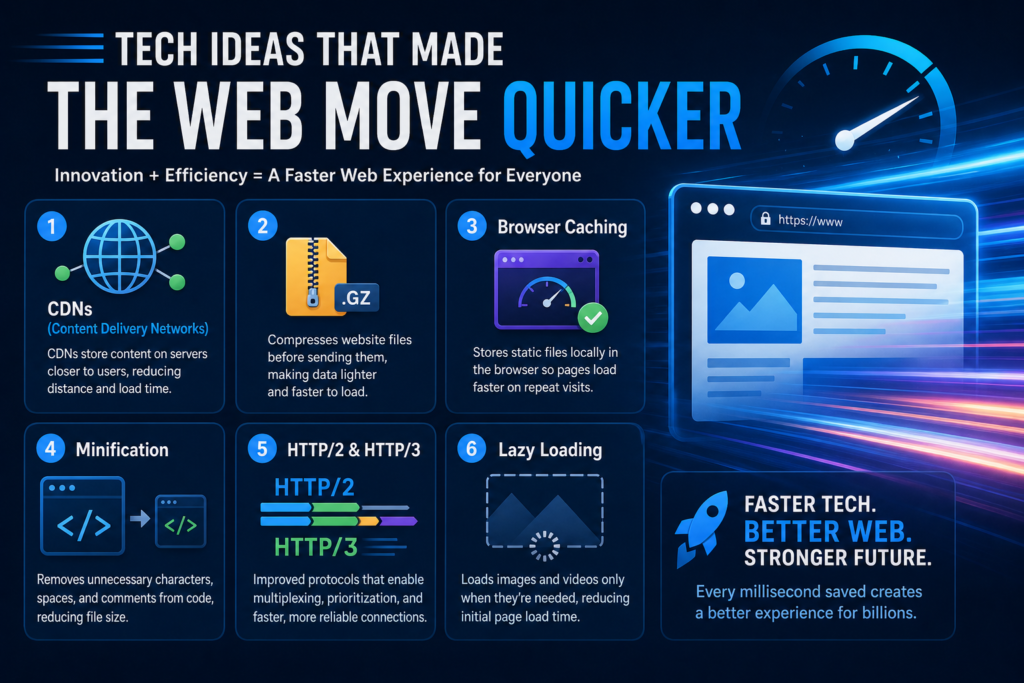
Tech Ideas That Made The Web Move Quicker
+
Table of Contents
I believe that with each passing day, new technological ideas are emerging. Because of these technological changes, the world of the internet is becoming much faster. The web is no longer as slow as it used to be; modern technology has made it significantly faster.
What Does “Faster Web” Mean?
You must have often heard people say that the world has become a global village. In my opinion, the simple meaning of this is that every person in the world is now connected through the internet. For example, if a businessman is sitting in one corner of the world, he can create a website and sell or deliver products to another corner of the world. Almost every person now has a mobile phone and can easily interact with others from one part of the world to another.
Also Read- Top 10 AI Tools for Creating Reels and Shorts Automatically
Core Technologies That Made the Web Move Quicker
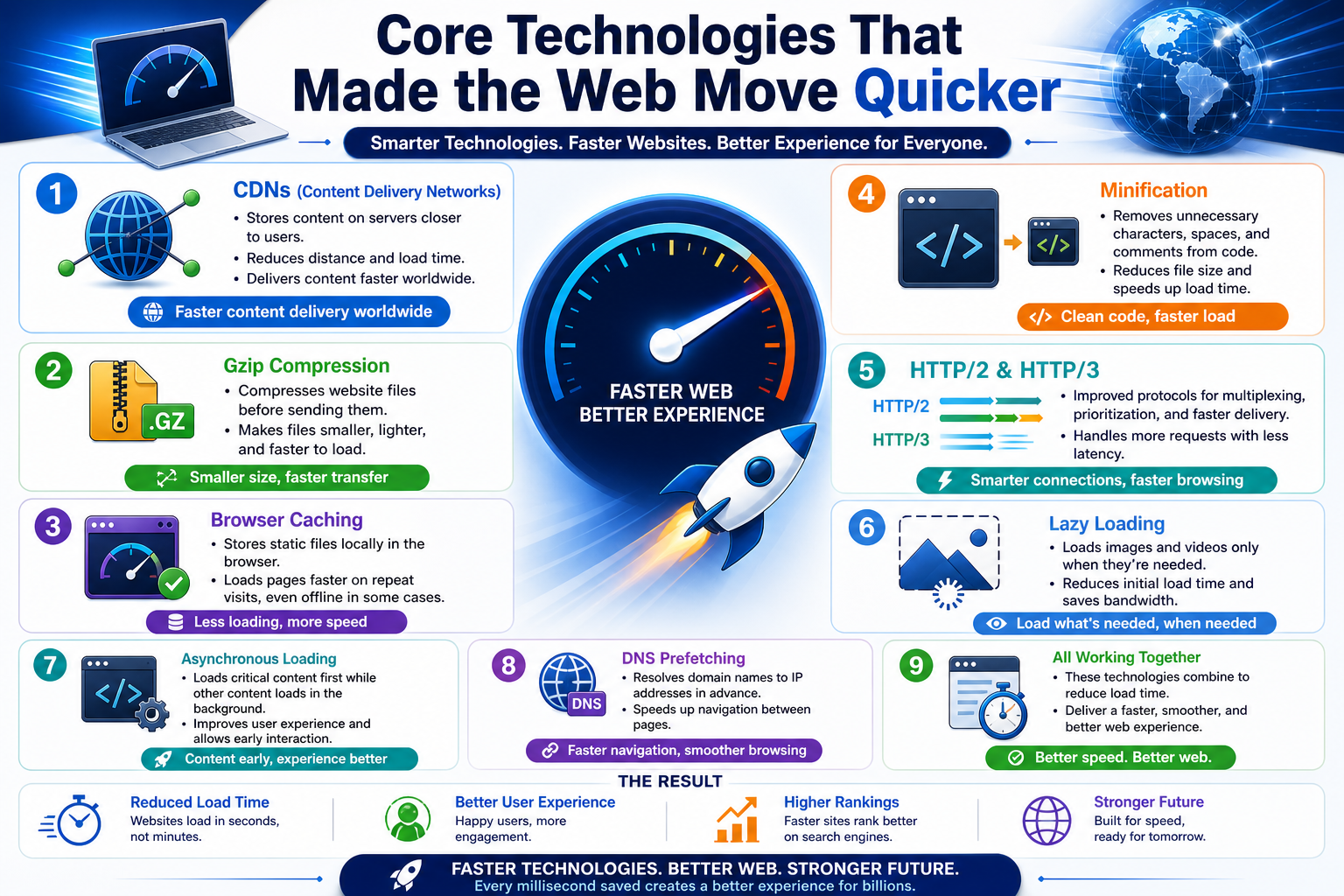
I will tell you about some core technological factors that have made the web much faster.
Content Delivery Network
Let me explain CDN with a very simple example. If we take the example of an office building, there are servers placed at different locations inside the building to handle communication. These servers connect the entire building together, and all the employees can easily interact with each other.
Similarly, across the world, there is a network of servers located in different places. This network connects the whole world. We call this a Content Delivery Network.
Through this system, people around the world can store their files or images on these servers and share them with others. These servers are very efficient and can interact with users from anywhere in the world.
Since these servers are spread across many locations globally, the speed of data transfer increases significantly. Imagine you send an email—it reaches a person sitting on the other side of the world with just one click.
This is an amazing technology that has made the entire internet much faster.
HTTP/2
The HTTP protocol is a technology used to load websites. HTTP/2 is its upgraded version. This new version is much faster than the previous version, HTTP/1.1.
It loads websites with images or heavy files much more quickly. As a result, users do not have to wait for long periods. With just one click, they can reach their desired page and use the website’s features.
So, we can say that with the introduction of HTTP/2, the process of accessing websites has become much faster. Now, website builders also upload complete and detailed files on their websites because they know users can easily access them due to this technology.
HTTP/3
This is the latest version of the HTTP protocol. It has made website loading even faster. Now, e-commerce websites that upload millions of products for selling can easily interact with users without delays.
The main reason for this improvement is HTTP/3. This technology has almost eliminated loading delays. Even issues caused by mobile network or Wi-Fi fluctuations do not affect its performance.
If one connection drops, it quickly switches to another connection without any interruption, so the user does not face any problem.
This technology has made the internet as fast as it can be. Even when the internet connection is slow, users do not face major difficulties in accessing websites.
Browser Caching
This is a technology that temporarily stores website information for faster access. We often notice that the websites we use frequently save their data in our browser. This is called caching technology.
It temporarily stores some information so that every time the website is loaded, it can be accessed instantly from your device. The main purpose of this technology is to make the web faster.
Now, frequently used data can be accessed directly from your browser instead of being loaded again from the server. In some cases, it even works when you do not have an internet connection, allowing you to access stored data from your browser.
I have personally experienced this as well, where even after losing internet connection, I was still able to access certain data from my browser.
This technology has taken the web one step forward and made it significantly faster.
Gzip Compression
This is a technology that automatically reduces website files. These reduced (compressed) files are easily accessed in the browser.
Indeed, a compressed file moves much faster on the internet compared to a heavy file. Now, website builders do not need to manually reduce file size.
With this technology, files are automatically compressed before being sent to the browser. This significantly increases the speed of the web.
Lazy Loading
This is a technology that loads website content based on need. It loads videos only when you scroll to them. It does not load unnecessary data.
Because of lazy loading, there is a noticeable improvement in internet speed. When you load files only as needed, they naturally load faster. It also prevents unnecessary data from loading, which helps keep the internet fast and efficient.
Minification
Minification is a technology that automatically removes unnecessary elements from files. For example, while creating a web page, developers often leave spaces, line breaks, and comments in the code. These can affect the speed of a website.
This technology automatically removes such unnecessary parts so that the web page loads faster without delays.
We can say that this technology also plays an important role in the web more quickly.
Asynchronous Loading
This is a technology that loads website content in the background. As we know, sometimes multiple types of content are required from a website. This technology displays the main content that the user needs to see first, while loading the supporting content in the background.
Because of this, the user experience improves significantly. It allows users to interact with the page even before it has fully loaded.
Overall, we can say that this technology starts fulfilling user needs even before the entire page finishes loading.
DNS Prefetching
This technology converts website names into IP addresses. As we know, every webpage has its own IP address. When a user moves from one page of a website to another, this technology helps switch quickly by resolving the IP addresses in advance.
Because of this, it makes navigation faster and smoother. Overall, it has greatly improved the browsing experience.
Why This Matters for Everyday Users
I believe that the world has become a global village. Everyone living in it now wants to be connected to the internet. Fast website services are beneficial for everyone.
For example, a professional doctor sitting in one part of the world can interact with a patient sitting in another part. All of this is possible because of fast internet.
If the internet speed were not fast, none of this would be possible. I believe that these small technologies, which have increased internet speed, are benefiting people all over the world.
The faster information is shared among people, the faster humanity will progress.
Conclusion
I believe that technology is playing its role in every field of the world. But the development of the internet is the mother of all things. Many technological factors are playing their own role in the advancement of the internet.
For example, some technologies make website content accessible, while others load website content according to the user’s needs.
In this article, we have discussed several technologies in detail that are making the web work much faster.
At the point where the world stands today, internet speed has never been this fast before. All of this has become possible because of these technological ideas.
FAQs
-
What is the main purpose of web speed technologies?
The main purpose of web speed technologies is to load website content quickly and improve user experience.
-
Do these technologies work automatically for users?
Yes, users usually do not know about these technical processes. However, these technologies work on their behalf, such as compressing files and saving data in browser cache memory. This improves overall speed and enhances user experience.
-
Are these technologies important for mobile users?
Yes, absolutely. Mobile users also use the internet, and these technologies help web pages load quickly on mobile devices under the same principles.
-
Do these technologies help in SEO ranking?
Yes, in my opinion, they do. If a website loads faster, it has a better chance of performing well in search engine rankings.
-
Are these technologies important for cybersecurity?
Yes, cybersecurity is a major concern in today’s world. Many of these technologies help protect user data and ensure smooth internet access without unnecessary interruptions.