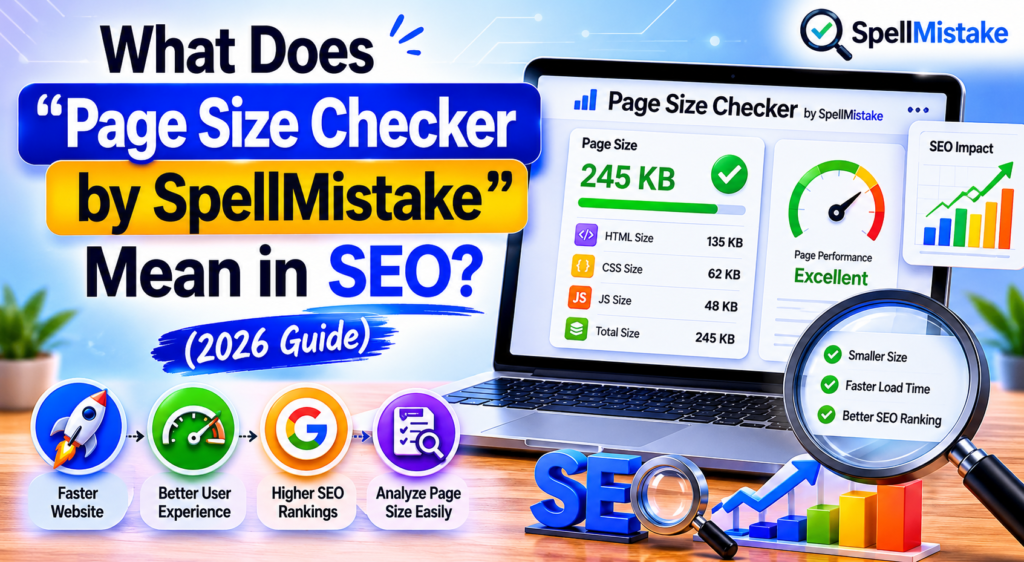
What Does “Page Size Checker by SpellMistake” Mean in SEO? (2026 Guide)
+
Table of Contents
- 1 What Is a Page Size Checker?
- 2 What Are Spellmistake Queries?
- 3 How SEO Experts Fix These Problems
- 3.1 Page Rendering Time
- 3.2 Large Page Sizes
- 3.3 Too Many HTTP Requests
- 3.4 Use Only AVIF and WebP Formats
- 3.5 Content Delivery Network (CDN)
- 3.6 Natural Language Processing (NLP)
- 3.7 Search Intent Optimization
- 3.8 How Google Understands Typo-Based Search Queries
- 4 Good and Bad SEO Comparison
- 5 Quick Summary
- 5.1 FAQs
To stay at the top of any search engine, people work very hard. Every website owner dreams of ranking in the top 10 positions because we have seen that users mostly visit websites that appear on the first page of search results.
Visiting those websites means that users trust them to find the solutions they are looking for. In simple words, reaching the top 10 positions is extremely important for selling products or services online.
The person who guides website owners in achieving better rankings is called an SEO expert. An SEO expert helps website owners in many areas that contribute to website rankings.
One of the major factors among them is the Page Size Checker. The smaller and lighter a webpage is, the better it can perform in search rankings. Search engines analyze many factors before placing a website at the top, and page size is one of those important ranking factors.
At the same time, we should also understand how search engines identify spelling mistakes typed by users. Sometimes users have a clear idea in their minds, but while typing, they make spelling mistakes.
In this article, I will share my personal experience and explain how these two factors can affect your website rankings.
Before going into details, let us first understand what Page Size Checker and spelling mistake queries actually are.
What Is a Page Size Checker?
When we build a website, it contains many pages. For example, the homepage usually includes a brief introduction to the company along with images, videos, and other elements designed to attract visitors. But while adding all this information, website owners often ignore the fact that uploading too many images and files increases the overall size of the webpage.
The tools used to measure the size of a webpage are called Page Size Checkers. These tools tell you how large your webpage is and whether its size could negatively affect search engine rankings.
If a webpage is too heavy, it may load slowly. That may create a poor user experience. By using page size checker tools, you can check and reduce the webpage size to improve performance.
What Are Spellmistake Queries?
Search engines have become very smart today. Unlike in the past, they no longer rely only on exact spelling matches to show results. Instead, modern search engines try to understand the intent behind a user’s search query and then provide the most relevant results.
Sometimes users are searching for a specific solution, but while typing, they accidentally make spelling mistakes. Search engines analyze these misspelled words and try to understand the actual meaning behind them.
Based on that understanding, they attempt to show users the most relevant websites. In many cases, search engines successfully identify the correct intent, but sometimes they may still display irrelevant or incorrect websites.
Now that we understand both of these factors, let us explore how SEO experts analyze and improve them to help websites achieve better rankings in search engines.
How SEO Experts Fix These Problems
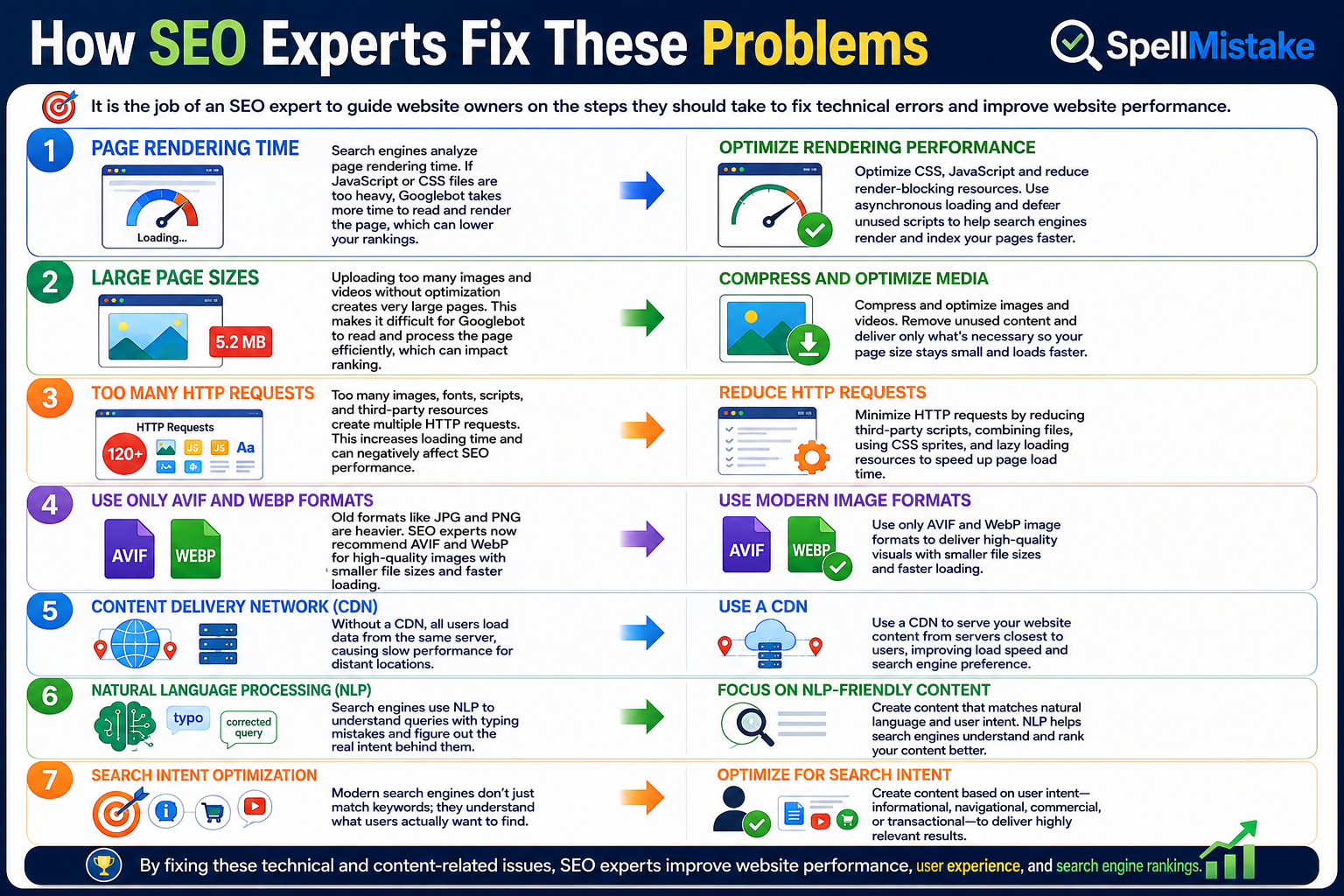
It is the job of an SEO expert to guide website owners on the steps they should take to fix technical errors and improve website performance.
Page Rendering Time
I have noticed that search engines not only analyze content, but they also analyze page rendering time. If JavaScript or CSS files are too heavy, then Googlebot takes more time to read and render the page.
Search engines keep this factor in mind, and when showing results to users, they may rank your website lower because of slow rendering performance.
Large Page Sizes
Sometimes, website owners are unaware that they have created pages with very large sizes. They upload too many images and videos without optimization. As a result, Googlebot faces difficulty reading the page efficiently. When the page takes longer to load and process, search engines may reduce its ranking priority.
Too Many HTTP Requests
If a webpage contains too many HTTP requests, such as multiple images, fonts, scripts, and third-party resources, Googlebot may require more time to fully load and analyze the page. This extra loading time can negatively affect your website’s SEO performance and reduce search engine preference.
Use Only AVIF and WebP Formats
Search engine standards have changed significantly over time. In the past, website owners mainly uploaded JPG and PNG files. However, I have noticed that many SEO experts now recommend using only AVIF and WebP image formats. These formats improve loading speed because they provide high-quality images with smaller file sizes. This helps improve search performance and user experience.
Content Delivery Network (CDN)
I have observed that many SEO experts now use Content Delivery Networks (CDNs) so that website data can load from the server closest to the user. This helps improve website loading speed. When search engines can read and process a website quickly, the probability of achieving better rankings increases.
Natural Language Processing (NLP)
Search engines and AI systems have worked extensively to solve issues related to typing mistakes in search queries. Today, queries containing spelling errors are analyzed using Natural Language Processing (NLP).
Search engines attempt to understand the real intent behind the user’s query and then show the most relevant websites based on that understanding.
Search Intent Optimization
This is a very modern concept, and understanding it has become extremely important in today’s AI-driven SEO world. Modern search engines do not simply match keywords anymore. Instead, they try to understand what is happening in the user’s mind and what the user actually wants to find.
This process is known as Search Intent Optimization. Based on user intent, search engines try to display the most relevant and useful results possible.
Also Read- Droven io Cybersecurity Updates: 2026 Comprehensive Guide
How Google Understands Typo-Based Search Queries
This is a very important question in 2026. Many SEO experts are still struggling to fully understand how search engines process typo-based queries and how this concept can be successfully applied in SEO projects. Search engines have never clearly explained their complete policy regarding this issue.
But one thing is obvious: their first attempt is usually to automatically correct the spelling mistake made by the user and then perform the search based on the corrected query.
But in many cases, spelling mistakes are so unusual that it becomes difficult for search engines to identify the intended keyword correctly. In such situations, search engines try to understand the overall intent behind the keyword rather than focusing only on exact spelling.
Google now also analyzes a user’s previous searches and browsing behavior before making a decision.
This is part of a semantic process that works step by step. You can even say that modern search engines try to “read the user’s mind” to understand what the user actually wants.
After analyzing different signals, they attempt to show the best possible search results. Sometimes search engines successfully understand the intent, while other times they may still display irrelevant websites.
Good and Bad SEO Comparison
| Factor | Bad for SEO | Good for SEO |
| Image Format | PNG/JPG | WebP/AVIF |
| Page Size | 5MB+ | Under 2MB |
| Loading Speed | Slow | Fast |
| User Experience | Poor | Smooth |
Best Tools to Check Website Page Size
Today, there are many tools available in the market that allow website owners and SEO experts to check webpage size and performance. These tools help identify which files are heavy and how they can be optimized for better loading speed and SEO performance.
I have personally used many of these tools and achieved good results. Some of my favorite tools are listed below:
- Google PageSpeed Insights
- GTmetrix
- DebugBear
- Pingdom Website Speed Test
Quick Summary
I believe that these strategies have changed significantly over time. Every SEO expert should continuously upgrade their skills according to modern trends and search engine updates.
Search engines now consider many ranking factors. In these factors, Page Size Checker by spellmistake analysis has become important.
You should always use reliable tools that provide accurate information about your webpage size and performance. Spellmistake also play a very important role. Search engines have become so advanced that they no longer rely only on exact keyword matching.
Instead, they follow a semantic process to understand the exact intent behind a user’s search query. Only after understanding the user’s intent do they display the most relevant and useful search results.
FAQs
-
Does page size also affect mobile SEO rankings?
Yes, absolutely. Most SEO factors work similarly on both laptops and mobile devices. If a webpage is too heavy, it can slow down loading speed on mobile devices.
-
What should be the ideal webpage size from a 2026 SEO point of view?
Many SEO experts believe that a webpage should ideally remain under 2 MB. The smaller the page size, the easier it becomes for Googlebot to read.
-
Do third-party scripts increase page size?
Yes, third-party scripts such as tracking codes, widgets, and external tools can increase webpage size significantly. Many SEO experts advise reducing unnecessary scripts to improve loading speed and website performance.
-
Why do search engines sometimes show results for incorrect keywords?
Search engines have become very smart today. Instead of only matching exact keywords, they try to understand the user’s intent behind the search query. Based on that understanding, they display the most relevant results even if the spelling is incorrect.
-
How can website owners check webpage size?
There are many tools available in the market that allow website owners to check webpage size. By using these tools, you can monitor which pages.
In my opinion, webpage size should always remain smaller in size. Because in this way, it is easier for search bots to read and process content efficiently.