3D Printing: How It Works, Applications, Advantages, and Examples
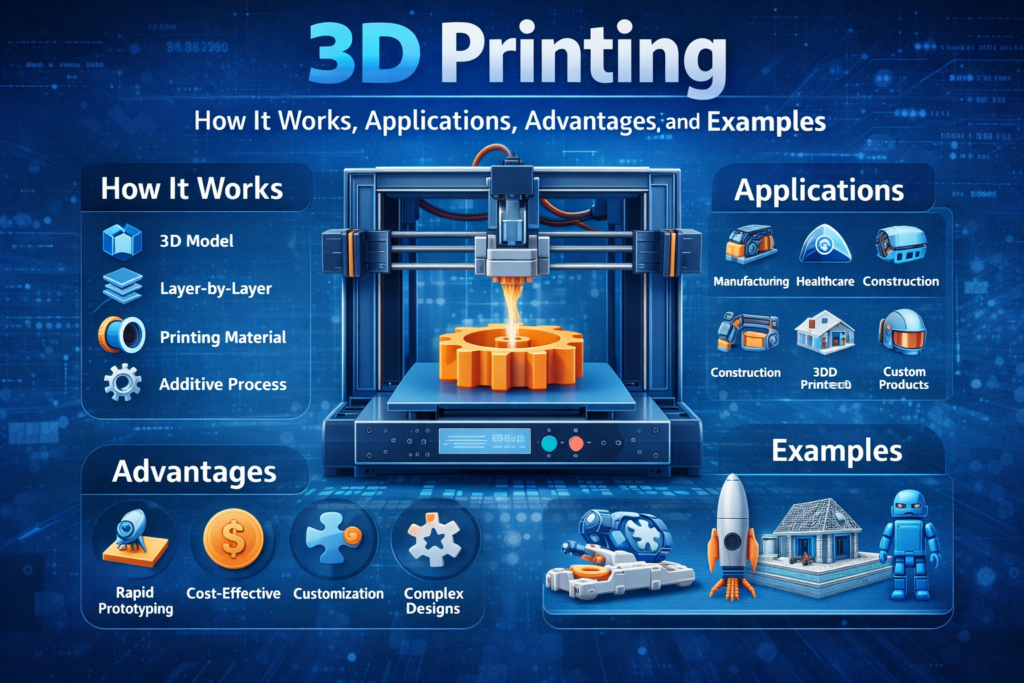
3D printing is available for anything from prototypes and manufacturing to healthcare, construction, and food.
3D printing is a disruptive technology that has changed the way we think about creating things. It employs specialized equipment to render solid, three-dimensional objects from digital files.
The process of 3-D printing has developed over the decades, since the 1980s, when Charles W. Hull invented the first 3D-printed part. Since then, 3D printing has branched into industries far and wide, and it has released the potential of so many.
What Is 3D Printing?
3D printing is the fabrication of objects through the build-up of material, especially filamentous material, according to computer-assisted design (CAD) files. The files serve as a blueprint for 3D printers to quickly create the selected object from different substances – including plastics, metals, and, in the future, bio-materials. It is sometimes called “additive manufacturing” because materials are added layer upon layer to make a finished product, in contrast to “subtractive manufacturing,” which removes material from a solid block.
The key point about 3D printing is that it manufactures complex bespoke objects using very high precision. “Even before today, I have seen it used in healthcare, in architecture, in education, and even in food production, in manufacturing,g and in automotive, but most of all, something like CRISPR could have applications that we have not even dreamed of yet.
How Does a 3D Printer Work?
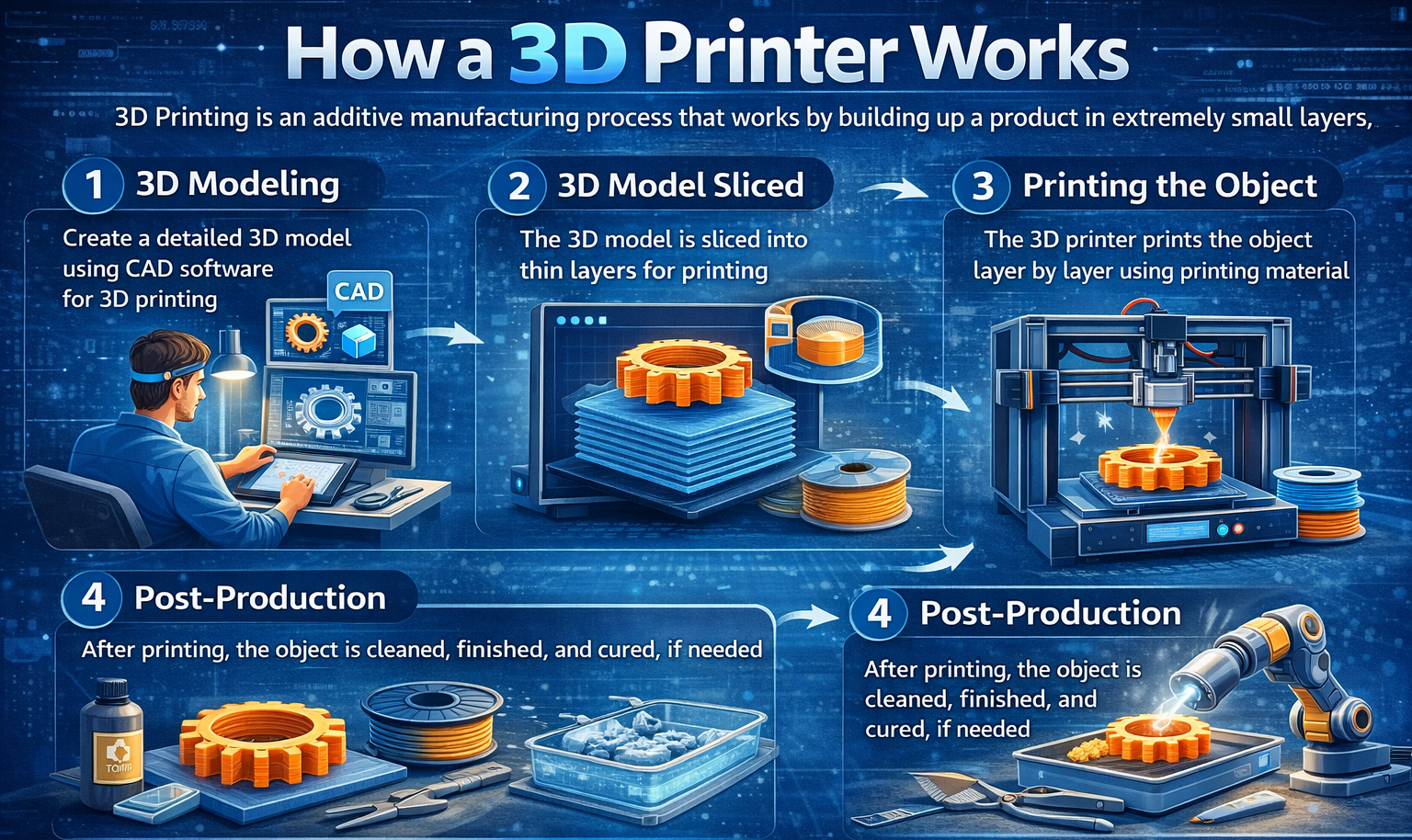
3D Printing is an additive manufacturing process that works by building up a product in extremely small layers, one at a time. Here’s what a 3D printer does:
- 3D Modeling: To 3D print an object, you need to first create the object using a 3D modeling software (CAD software). This figure represents the object in accurate detail. CAD software gives creators the ability to create even the most complex designs, so it is excellent for industries that require an extremely high level of accuracy,y like dentistry and aerospace.
- 3D Model Sliced: When the 3D model is completed, it’s sliced into thin layers horizontally by slicing software. The slicing software takes apart the model into manageable bits, then instructs the printer where to move and what to fill in. Essentially, it just preps the object for print, telling the printer to follow very specific instructions each layer of the way.
- Printing the Object: Once sliced, the 3D printer takes over from here. The printer slides a nozzle or laser across and back, layer upon layer, adding material. The material used, whether it’s plastic or resin, solidifies after it’s deposited, and the printer then moves to the next layer on top of it. By continued repetition of the process,s the object is completed.
- Post-Production: After the object has been printed, it may need to undergo post-processing to soften its rough edges, to peel away support material, or give it a better finish. Extension: Some items may require further processes, such as heat curing to increase strength and resilience.
Types of 3D Printers
3D printers come in many forms and employ a variety of techniques to make objects. The most popular three:
- Stereolithography (SLA) Printers: Such printers work by curing liquid resin into plastic with a laser. The laser cures the resin one layer at a time, making SLA great for intricate objects like jewelry or dental models.
- Selective Laser Sintering (SLS) Printers: AAnSLS printer sinters powder polymer particles together with a high-powered laser to create an object. SLS printers are widely used for functional parts in aerospace and automotive because they can be made from strong materials like nylon and metal.
- Fused Deposition Modeling (FDM): FDM is a type of 3D printer available in the market. It works by melting the plastic filament and pushing it out through a nozzle. Not only this, the printer adds the material layer by layer to create a 3D object. It is quite popular because they are affordable and quite simple to use.
Conclusion
3D printing is one of the forefront technologies, making it possible to build designs quickly. The capacity of the technique to manufacture bespoke, intricate,e and accurate items rapidly and at low cost means that it has become indispensable to many industries – from health to construction, and from aerospace to food production.
Although 3D printing has its downsides, such as material strength, dimensional accuracy, and post-processing needs, the benefits of 3D printing, ranging from cheapness to speed and flexibility, make this technology an asset when it comes to prototyping and producing devices.
As 3D printing technology advances, it is set to play a larger role in moulding the manufacturing, medical, and other industries in the future, acting as a technical fix to some of the world’s problems.
Frequently Asked Questions
-
What is 3D printing?
3D printing is a method where three dimensional objects are made by adding material in layers according to a digital design. It is employed across a range of industries, such as manufacturing, healthcare, and construction.
-
How does a 3D printer work?
A 3D printer reads a digital design (typically created in CAD software) and lays down material layer upon layer to build a product. The desired end product is built from layers of material (plastic, metal, resin) that are deposited, and then hardened.
-
What can 3D printing be used for?
People print in materials including plastics (such as ABS), metals, carbon fiber, and even substances such as wood and food! Material selection is based off the application.
-
What are the benefits of 3D printing?
Some advantages of 3D printing are that it is cheap and fast, it can be made to order and it can be used to make complicated shapes that are difficult to obtain with traditional manufacture.
-
Which industries are using 3D printing?
3D printing is applied across several fields of industry such as automobile, food, fashion and health industry as well as the construction sector.
-
Is 3D a possibility for mass production?
Although 3D printing is perfect for prototyping and small jobs, it is not currently the fastest process for mass production as production is slower than in traditional manufacturing.
-
What’s next for 3D printing?
The future is bright for 3D printing, as technology, materials and speed keep making progress. And it has the potential to transform fields including health care, construction and aerospace, offering novel remedies to those with intractable problems.