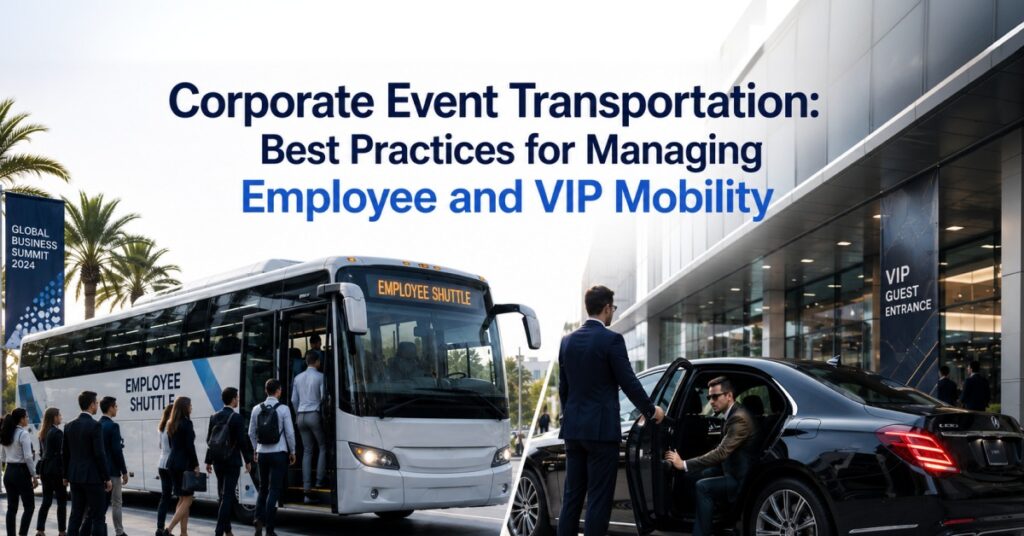
Corporate Event Transportation: Best Practices for Managing Employee and VIP Mobility
+
Table of Contents
- 1 Why Corporate Event Transportation Deserves Its Own Strategy
- 1.1 Two Very Different Passenger Groups
- 1.2 The Move Toward Centralized Ground Transportation Programs
- 1.3 What Rising Event Budgets Mean for Transportation Planning
- 2 Employee Mobility in Corporate Event Transportation
- 2.1 Route Planning and Scheduling at Scale
- 2.2 Common Failure Points in Manual Coordination
- 2.3 Real Example: Expedia Group’s Commute Program
- 2.4 Real-Time Tracking and Self-Service Booking as the New Baseline
- 3 VIP Mobility in Corporate Event Transportation
- 3.1 What Makes VIP Transportation Different
- 3.2 Security as a Planning Input, Not an Afterthought
- 3.3 Dedicated Dispatch and a Single Point of Contact
- 3.4 Contingency Planning for VIP Routes
- 4 The Common Thread: Technology as the Operational Backbone
- 4.1 Centralized Dashboards for Full Visibility
- 4.2 Role-Based Access for Different User Types
- 4.3 Automated Dispatching With Manual Override
- 4.4 Analytics and Post-Event Reporting
- 4.5 The Limits of Generic Ride Hailing Apps
- 4.6 The Limits of Spreadsheets and Manual Dispatch
- 4.7 The Data Ownership Gap
- 4.8 The Case for a White Labeled Corporate Event Transportation Platform
- 4.8.1 What White Label Transportation Software Actually Means
- 4.8.2 Faster Time To Market Than Building In-House
- 4.8.3 Full Control Over Branding, Data, and Guest Experience
- 4.8.4 One System For Both Employee and VIP Workflows
- 4.8.5 Scalability For Recurring and Multi-City Programs
- 4.8.6 Proven Experience With Corporate and Event Use Cases
- 4.8.7 Real-Time Tracking and Communication Tools
- 4.8.8 Data Security and Privacy Compliance
- 4.8.9 A Track Record of Successful White Label Deployments
- 4.9 Bringing It Together: A Practical Framework for Planners
- 5 Conclusion
- 5.1 Frequently Asked Questions
- 5.1.1 Q. How long does it take to launch a white label platform?
- 5.1.2 Q. Can the platform handle both employee and VIP transportation?
- 5.1.3 Q. Will we own our guest and ride data?
- 5.1.4 Q. How much can we customize the branding and features?
- 5.1.5 Q. Does the software scale across multiple cities or events?
Corporate events run on details. Venues get booked months ahead, speakers get confirmed, and menus get finalized down to the last course. Transportation, however, often sits at the bottom of that list, treated as a task to sort out later.
That approach carries real risk. A late VIP guest can overshadow an otherwise perfect event. A missed employee shuttle can sour a team’s mood before the day even starts. Corporate event transportation is not a side detail. It is the first and last impression your event leaves behind.
The global corporate event market is not small. It is projected to grow to $595.27 billion by 2029, according to Booking.com for Business. And transportation plays a key role in making these events successful.
This blog covers practical best practices for managing both employee and VIP mobility. It also explains why organizations are moving toward dedicated event transportation solutions and how they replace old spreadsheets and phone calls.
Why Corporate Event Transportation Deserves Its Own Strategy
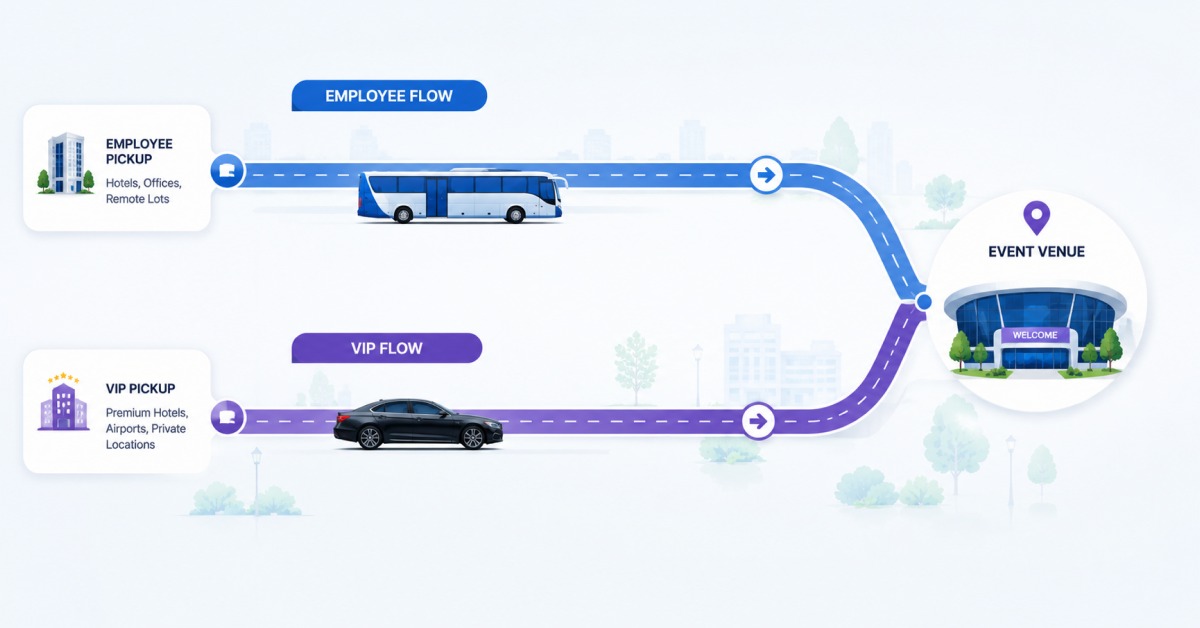
Corporate event transportation is not a single task inside event planning. It is a distinct operation with its own risks, timelines, and passenger expectations. Treating it as an afterthought is where most event day problems start.
-
Two Very Different Passenger Groups
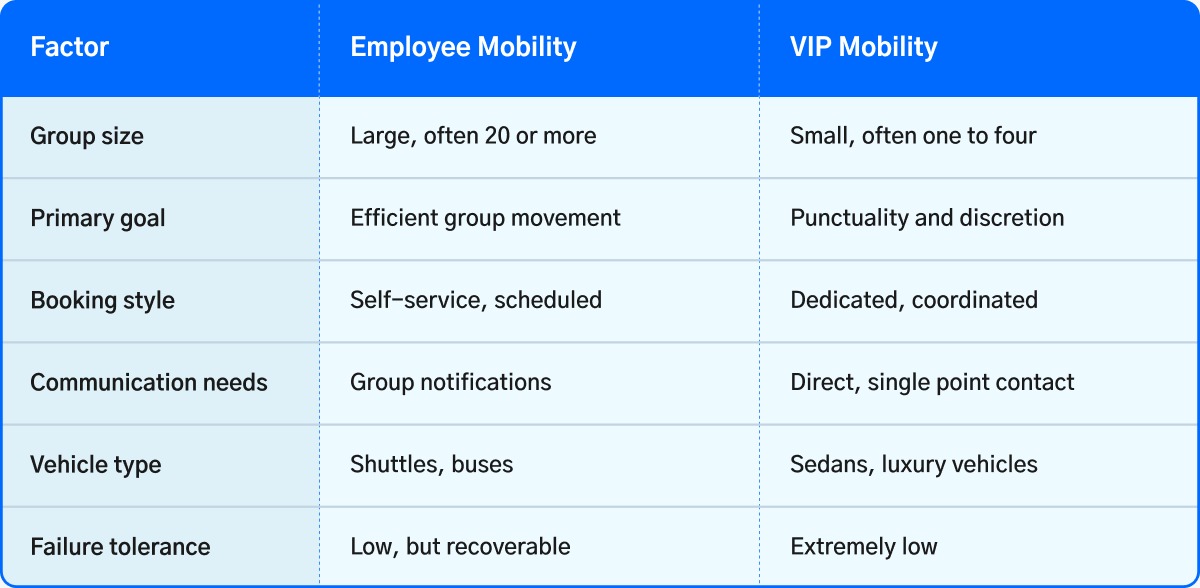
Every corporate event moves two very different types of people. Employees travel in groups, often on a fixed schedule. VIP guests travel alone or in small groups, with much less room for error.
A single shuttle delay affects one group of employees. A single VIP delay can affect an entire keynote or client meeting. Planning both groups under one corporate event transportation system takes real corporate mobility thinking. It goes far beyond simple vehicle booking alone.
-
The Move Toward Centralized Ground Transportation Programs
Organizations are moving away from booking rides in fragments. Instead, they are consolidating everything under one coordinated corporate event transportation program. This change allows real-time adjustments across airport pickups, venues, and hotels.
A centralized approach means one team sees the full picture. It reduces the back and forth between multiple vendors on event day. This is exactly where modern event transportation systems prove their value.
-
What Rising Event Budgets Mean for Transportation Planning
Event costs are climbing, and transportation is part of that trend. Meeting and events costs rose 3.7 percent in 2025. They will rise another 2.4 percent in 2026, reaching 172 dollars per attendee per day, according to the Global Business Travel Association.
Transportation deserves the same budget scrutiny as venue and catering. A poorly planned route can quietly inflate costs through idle vehicles and overtime drivers. Smart planners now treat transportation scheduling software as a budget tool. It is not just an operational tool.
Employee Mobility in Corporate Event Transportation
Employee mobility is one half of a strong corporate event transportation plan. It is about volume, consistency, and clear communication. Get the basics right, and the rest of the event runs smoother.
Route Planning and Scheduling at Scale
Corporate event transportation routes need realistic timing, not best-case assumptions. Build routes around actual traffic patterns, not an idealized map. Every stop should account for loading time, not just drive time.
Good employee transportation planning starts with a clear stop list. It also needs a schedule that survives a fifteen-minute delay without falling apart.
Common Failure Points in Manual Coordination
Manual coordination breaks down in predictable ways. These are the most common issues planners run into.
- Overbooked shuttles with no clear seat count
- Double-booked vehicles for overlapping time slots
- Last-minute changes tracked only through phone calls
- No shared record of who confirmed a ride
Each problem compounds as the group size grows. Past a few dozen people, the risk multiplies fast.
Real Example: Expedia Group’s Commute Program
Expedia Group faced a major mobility challenge during its move from Bellevue to Seattle. The company built a structured commute and shuttle program to manage the transition.
The results were measurable and clear to see. Drive-alone rates dropped from 59 percent to 13 percent. Shuttle usage reached 25 percent of total commute trips. Vanpool and carpool participation doubled to 22 percent.
This example shows what disciplined planning can achieve at scale. The same principles apply directly to single-event corporate event transportation logistics.
Real-Time Tracking and Self-Service Booking as the New Baseline
Riders now expect live tracking as a standard feature. Automatic ETAs reduce the constant “where is my ride?” questions. QR-based confirmations remove confusion at pickup points.
These features used to be premium additions. Today, they are the baseline for any serious event transport solutions provider.
VIP Mobility in Corporate Event Transportation
VIP mobility is the other half of a complete corporate event transportation plan. It operates on a different standard entirely. One late arrival can affect a keynote, a client meeting, or a media moment.
-
What Makes VIP Transportation Different
VIP transportation solution demands higher punctuality than any other part of the event. Vehicle quality and cleanliness matter more, since guests notice small details. Privacy also becomes a priority, especially for guests avoiding public attention.
-
Security as a Planning Input, Not an Afterthought
Security teams increasingly guide transportation decisions from the earliest planning stages. Executive protection concerns have grown in recent years. Public attention on corporate leaders keeps rising.
This means route planning now includes security review. It also means executive transportation decisions get made earlier in the process.
-
Dedicated Dispatch and a Single Point of Contact
VIP routes need separation from the general corporate event transportation dispatch system. A shared help desk creates delays when something urgent comes up.
A named coordinator per VIP guest solves this problem directly. That person tracks the guest’s full itinerary and handles changes in real time.
-
Contingency Planning for VIP Routes
Every VIP route needs a backup plan built in advance. Alternate routes should be mapped before traffic becomes a problem. Backup drivers should be on standby, not called in after a delay starts. Real-time rerouting during weather or road closures keeps the schedule intact.
The Common Thread: Technology as the Operational Backbone
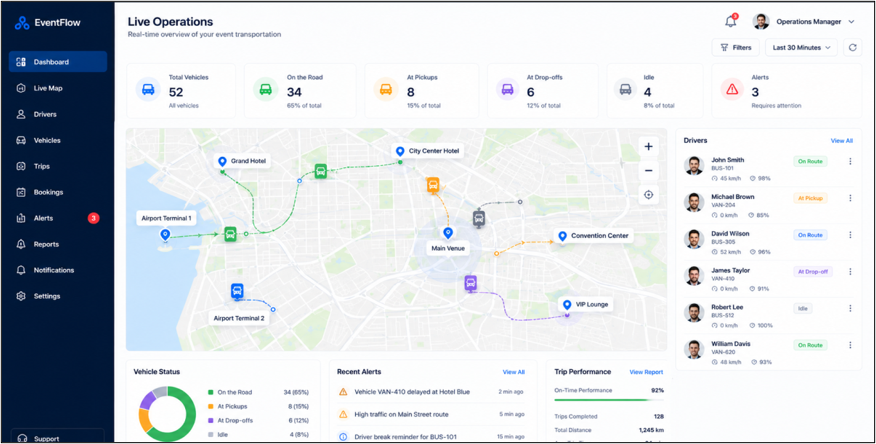
Employee mobility and VIP mobility point to the same underlying need. Both require a unified corporate event transportation system built for different passenger types.
-
Centralized Dashboards for Full Visibility
A single dashboard lets planners monitor every corporate event transportation route in one place. This removes the need to juggle multiple tools during a live event.
-
Role-Based Access for Different User Types
Employees, VIP guests, drivers, and administrators all need different views. Role-based access means each user sees only what applies to them. This keeps the system simple, even when the event itself is complex.
-
Automated Dispatching With Manual Override
Automation should handle routine assignments without constant human input. A manual override option still matters for last-minute exceptions. The best event transportation systems balance both without slowing anyone down.
-
Analytics and Post-Event Reporting
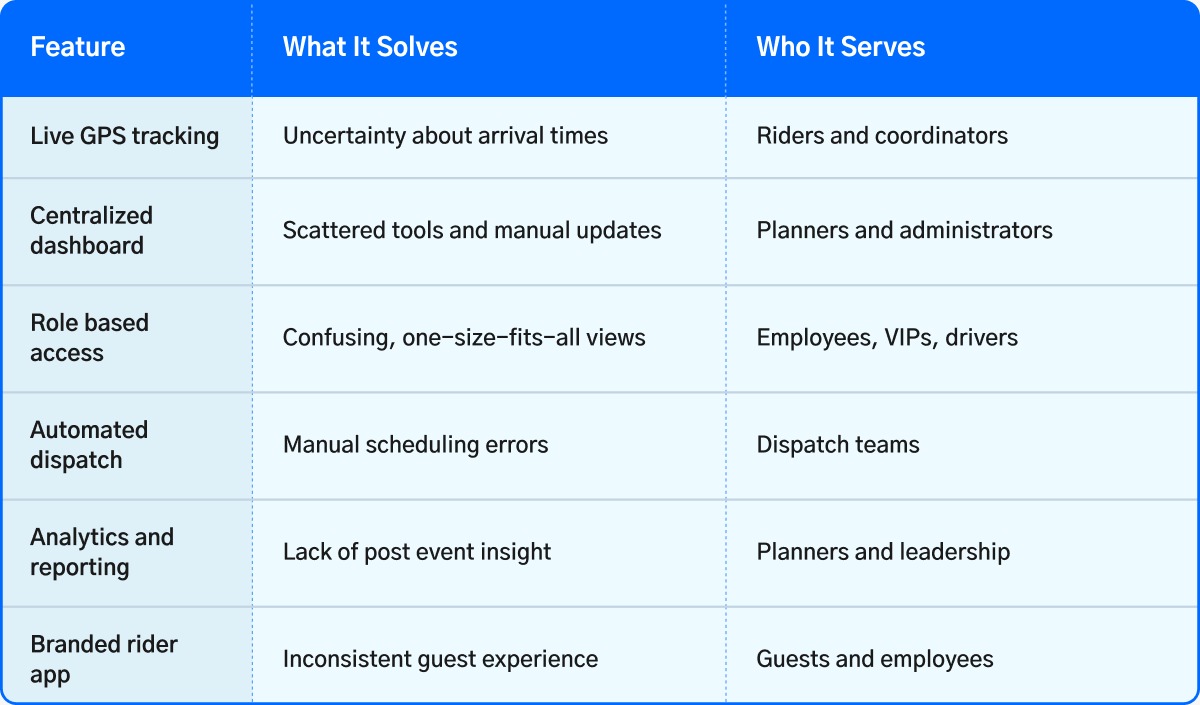
Data collected during the event improves the next one. Route performance and booking patterns reveal what worked and what did not. This turns every event into a learning opportunity for the next.
Why Off-the-Shelf Tools Fall Short For Growing Organizations
Generic tools work fine for small or one-time corporate event transportation needs. They struggle once event frequency or group size increases.
-
The Limits of Generic Ride Hailing Apps
Consumer ride apps offer no branding control for your corporate event transportation program. They also lack group coordination features built for corporate use. VIP specific workflows simply do not exist in these platforms.
-
The Limits of Spreadsheets and Manual Dispatch
A spreadsheet can manage twenty employees without much trouble. That same spreadsheet becomes unmanageable at two hundred employees across multiple events. Manual dispatch adds human error into a process that should run smoothly.
-
The Data Ownership Gap
Third-party consumer platforms rarely give companies ownership of their own data. Guest history, ride patterns, and branding all stay with the platform, not the client. This gap becomes a real problem as event programs grow.
The Case for a White Labeled Corporate Event Transportation Platform
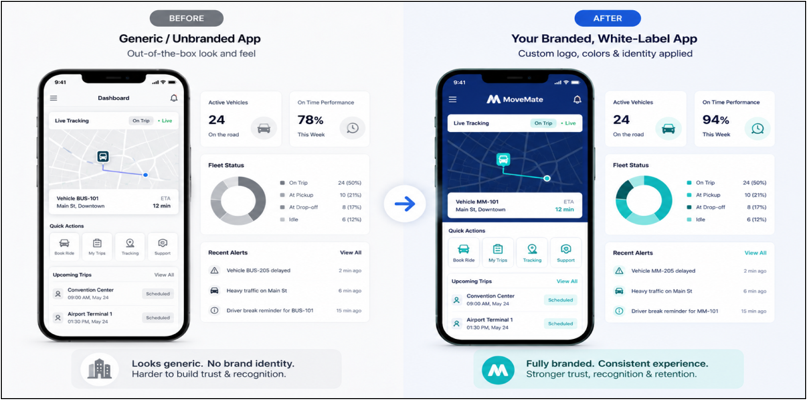
More organizations now choose white label corporate event transportation platforms. They pick this route over building from scratch. This section is for teams evaluating that decision.
-
What White Label Transportation Software Actually Means
White label corporate event transportation software is a fully branded platform. It runs on proven and thoroughly tested technology. Your company customizes it to match your own workflows and identity. The underlying engine stays reliable, while the branding stays yours entirely.
-
Faster Time To Market Than Building In-House
Building a custom corporate event transportation platform from scratch takes months, sometimes years. A white label solution launches in a fraction of that time. This speed matters when event schedules are already set.
-
Full Control Over Branding, Data, and Guest Experience
Your rider app, driver app, and dashboards all carry your own brand. Guest data and ride history stay fully within your organization. This level of control is difficult to achieve with third-party consumer apps.
-
One System For Both Employee and VIP Workflows
A single platform can support large-scale shuttle movement and premium VIP service together. There is no need to manage two separate systems for one event.
-
Scalability For Recurring and Multi-City Programs
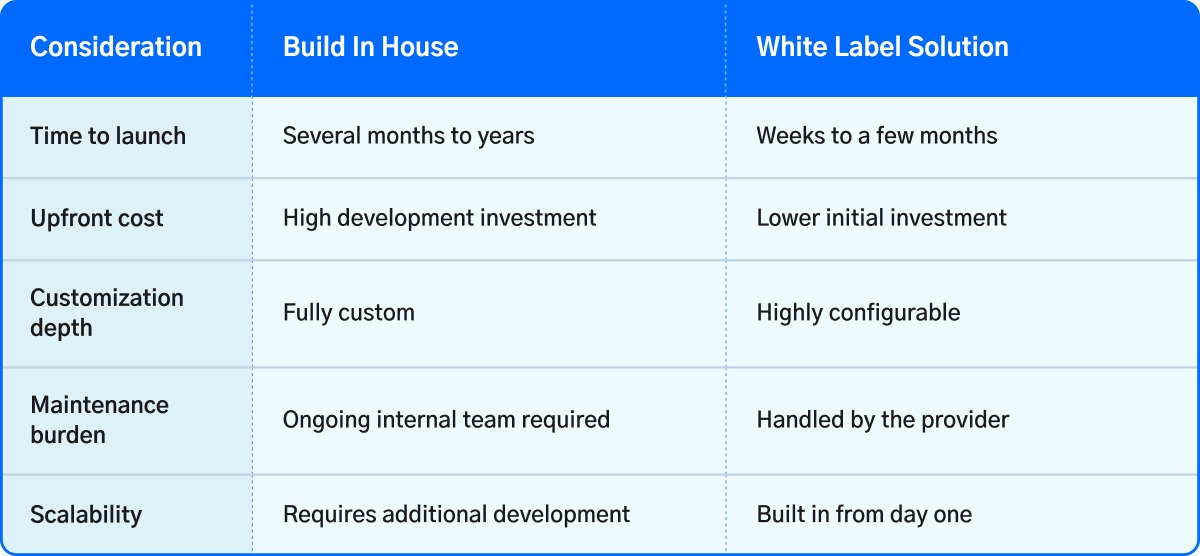
Companies running multiple events per year benefit most from this model. The same platform scales across new cities and growing guest lists. Corporate shuttle services become consistent, no matter where the event happens.
What to Look For When Choosing a Corporate Event Transportation Software Partner
Choosing a corporate event transportation partner matters as much as choosing the right features. Here is what separates a strong provider from a risky one.
-
Proven Experience With Corporate and Event Use Cases
A vendor with real corporate event transportation experience understands the stakes. A generic ride-hailing background does not translate to event day pressure.
-
Real-Time Tracking and Communication Tools
Live tracking and instant communication are baseline requirements now. Any provider missing these features is not ready for corporate use.
-
Data Security and Privacy Compliance
Guest and employee data protection should never be optional. This matters even more for VIP guest profiles and travel details.
-
A Track Record of Successful White Label Deployments
Ask for real deployment examples before signing any contract. What happens to your next event if the process fails at peak arrival hours? That single question reveals whether a provider is truly ready.
Bringing It Together: A Practical Framework for Planners
Good corporate event transportation planning follows a few consistent habits.
- Plan transportation timelines alongside venue booking, at the very start
- Keep employee and VIP workflows separate, even within one platform
- Invest in real-time visibility for both planners and riders
- Build redundancy into every route with backup vehicles and drivers
These habits turn transportation from a risk into a strength.
Conclusion
Transportation stays invisible when it works well. It becomes the only thing anyone remembers when it fails.
The market is already moving toward centralized event transportation solutions. Spreadsheets and phone calls cannot keep pace with growing event budgets and guest expectations.
Event volume and costs keep climbing every year. How ready is your transportation strategy for what comes next?
Explore a white-labeled corporate event transportation platform today. It is built for both employee and VIP mobility.
Frequently Asked Questions
Q. How long does it take to launch a white label platform?
Ans. It takes about a week or two to launch most platforms. This speed helps teams move fast on corporate event transportation without long development cycles.
Q. Can the platform handle both employee and VIP transportation?
Ans. Yes. One system can manage both groups at once. It supports employee transportation and premium guest service under a single dashboard.
Q. Will we own our guest and ride data?
Ans. Absolutely. Your company keeps full ownership of that data. This includes guest history, ride patterns, and every detail tied to VIP transportation.
Q. How much can we customize the branding and features?
Ans. You can customize branding and workflows. You can also configure the dashboard layout. A true white label platform adapts to your business.
Q. Does the software scale across multiple cities or events?
Ans. Of course. The same platform grows with your event calendar. It works well for corporate shuttle services across new cities and recurring programs.