How Outdated Data Undermines Infrastructure: Hidden Risks and Real-World Consequences
+
Table of Contents
Public utilities serve millions of people every day, yet the systems that manage them often lag decades behind the available technology. Water, sewer, and electricity services are critical infrastructure, and the administrative backbone supporting them determines how effectively local governments can serve the communities they are responsible for.
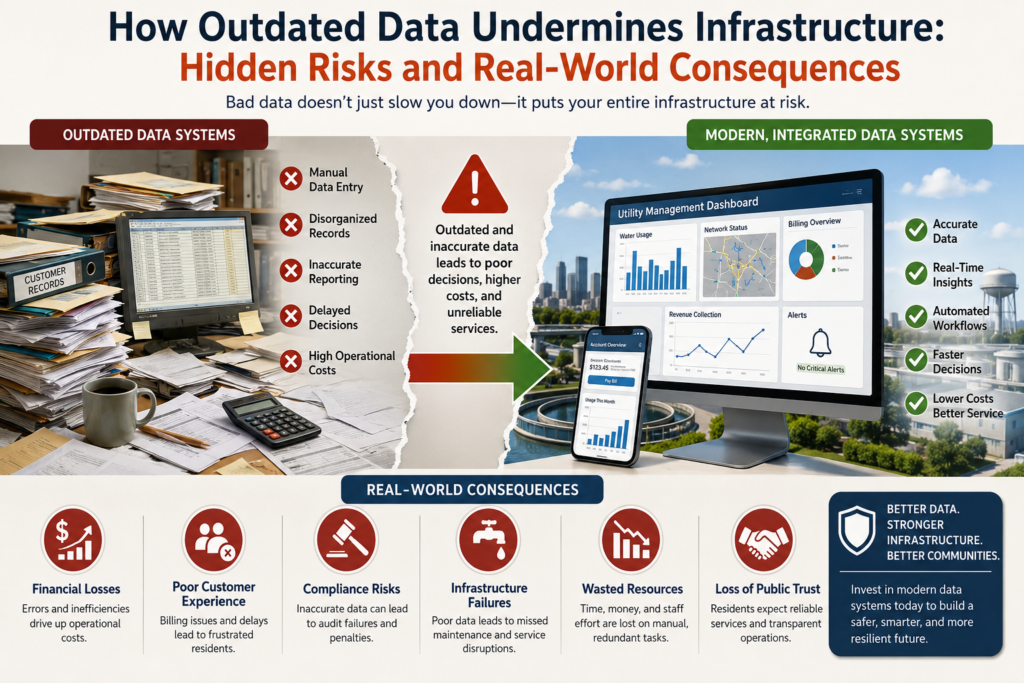
The gap between what is technically possible and what is currently operational is not simply a financial or bureaucratic challenge—it is fundamentally a data challenge. Outdated Data Undermines Infrastructure by creating inefficiencies that affect every aspect of utility operations, from billing accuracy and customer service to regulatory compliance and long-term planning. When organizations rely on legacy systems, disconnected databases, and manual processes, they struggle to maintain accurate and timely information. As a result, decision-makers often work with incomplete data, increasing the risk of errors, service disruptions, and wasted resources. Modernizing data management systems is essential for improving operational efficiency, enhancing public trust, and ensuring infrastructure can meet the demands of growing communities.
The Invisible Cost of Manual Processes
Many utility departments still depend on spreadsheets, paper-based records, and disconnected legacy software. While these methods may appear manageable on the surface, they often create hidden costs that grow over time. Every manual data entry task introduces the possibility of human error, and even small mistakes can have significant consequences.
For example, a billing discrepancy caused by a misread meter or incorrectly entered customer information can trigger a chain reaction of problems. Staff members may need to investigate records, contact customers, make adjustments, and document corrections. What begins as a minor issue can consume hours of administrative effort.
These inefficiencies extend beyond billing. Incomplete account histories can complicate audits, slow down customer service responses, and make it difficult to track usage trends accurately. Employees who should be focusing on improving services often spend valuable time reconciling data across multiple systems.
The problem is not limited to smaller municipalities. Utility departments of all sizes encounter similar challenges when their infrastructure relies on outdated technology. The longer these inefficiencies remain unresolved, the more resources are wasted on tasks that modern systems can automate with ease.
Why Data Quality Matters More Than Ever
Data is one of the most valuable assets a utility department possesses. Accurate information supports decision-making, financial planning, customer communication, and regulatory reporting. When data is outdated, duplicated, or inconsistent, the quality of every decision declines.
Poor data quality can lead to incorrect billing calculations, delayed maintenance schedules, inaccurate consumption forecasts, and compliance risks. Utility managers may struggle to identify trends because information is scattered across different databases or stored in formats that are difficult to analyze.
As communities grow and service demands increase, the importance of reliable data becomes even more critical. Modern utility operations require real-time visibility into customer accounts, infrastructure performance, and financial activity. Without trustworthy data, departments are forced to make decisions based on incomplete information.
What Automation Actually Changes
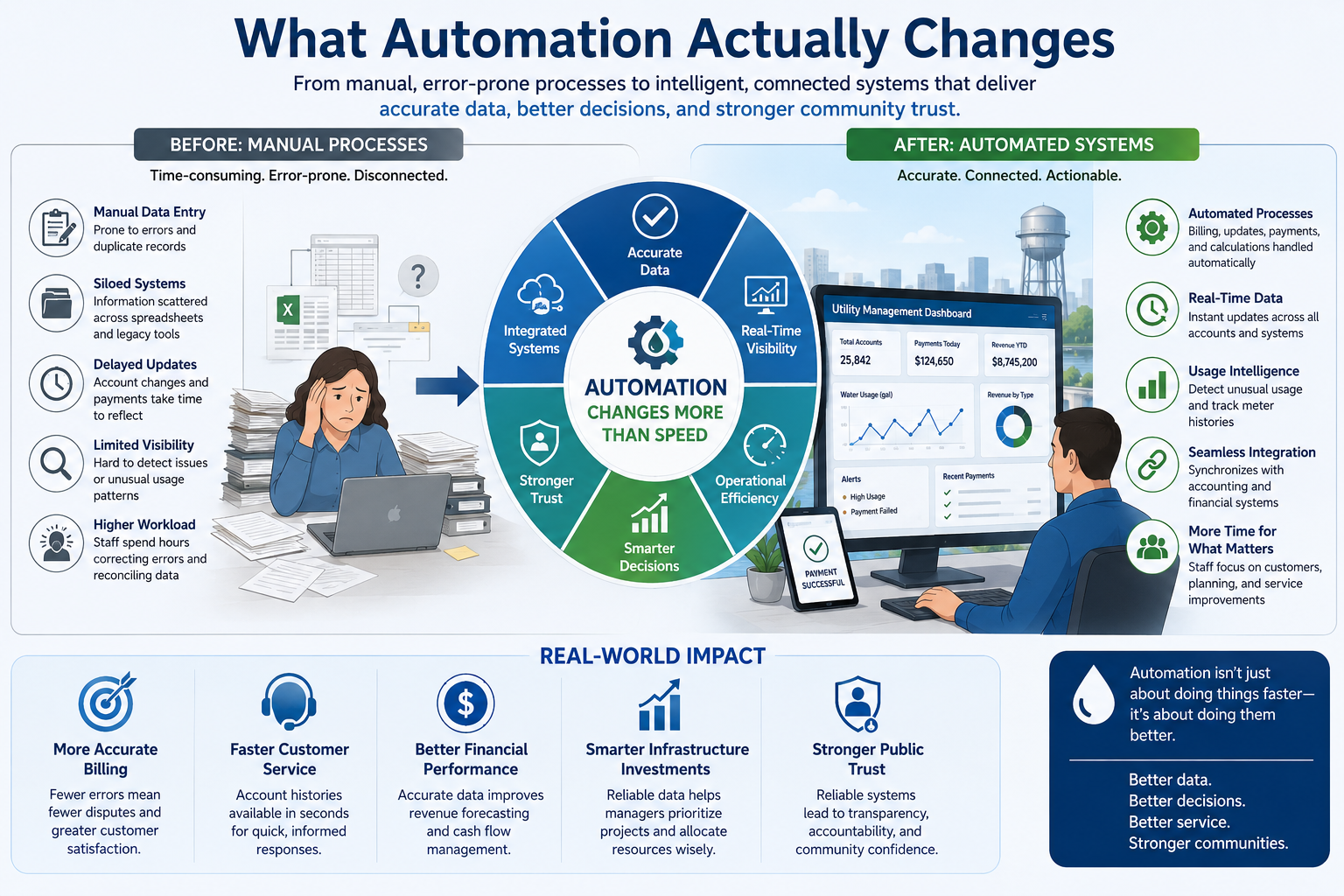
The transition from manual processes to automated utility management systems is about much more than speed. Automation fundamentally improves the quality, consistency, and accessibility of data throughout the organization.
When billing cycles, account updates, payment processing, and rate adjustments are managed automatically, the resulting data becomes more accurate and reliable. Employees spend less time correcting errors and more time focusing on higher-value activities.
Modern municipal water billing software, for example, does far more than generate invoices. It can identify unusual consumption patterns, track meter histories, automate deposit management, process payments, and synchronize financial records with accounting platforms in real time. These capabilities help departments maintain a complete and accurate picture of their operations.
The benefits extend beyond administrative convenience. With access to clean and current information, utility managers can identify issues earlier, forecast revenue more accurately, and make better-informed decisions about infrastructure investments.
Most importantly, automation reduces the risk of errors that can damage public trust. Customers receive more accurate bills, service inquiries are resolved faster, and account histories are available instantly when questions arise.
The Customer Experience Connection
Residents may never see the software utility departments use, but they experience its impact every day. Slow response times, inaccurate bills, and payment processing issues often stem from outdated administrative systems.
When customers contact a utility office with questions, they expect quick and accurate answers. If staff members must search through multiple databases or paper records to locate information, resolution times increase dramatically.
Integrated systems improve customer interactions by providing employees with immediate access to complete account histories. Representatives can review payment records, service requests, usage data, and previous communications from a single interface. This streamlined approach leads to faster service and greater customer satisfaction.
Modern payment portals also make a significant difference. Residents increasingly expect convenient online payment options, automated reminders, and real-time account updates. Utility departments that continue relying on outdated systems may struggle to meet these expectations.
Data Integrity Is a Governance Issue
Utilities operate in a highly visible environment where accountability matters. Billing disputes, rate increases, infrastructure failures, and service interruptions often become matters of public concern.
When data systems are unreliable, responding to audits, council inquiries, or resident complaints becomes significantly more difficult. Missing records, inconsistent reports, and incomplete account histories can undermine confidence in a department’s operations.
Clean, accurate data is not simply a technical advantage—it is a governance requirement. Public agencies have a responsibility to maintain transparent and reliable records. Departments that invest in modern administrative systems are better positioned to demonstrate accountability and maintain public trust.
During regulatory reviews or financial audits, access to complete and accurate information can mean the difference between a smooth process and a costly investigation. Reliable data supports transparency and helps local governments make informed policy decisions.
Understanding the Resistance to Change
Despite the clear benefits of modernization, many utility departments hesitate to replace legacy systems. The reasons are understandable.
Cost is often the first concern. New software platforms require financial investment, and budget constraints can make large technology projects difficult to justify. There are also concerns about operational disruption during implementation.
Data migration presents another challenge. Years of historical records may need to be transferred from outdated systems, and the process is rarely straightforward. Departments worry about losing information or encountering unexpected technical issues.
Staff adaptation is equally important. Employees who have used the same processes for years may be hesitant to adopt new technology. Successful modernization requires training, communication, and ongoing support to ensure users feel confident with the new system.
These concerns are legitimate, but they should not prevent progress. In many cases, the long-term costs of maintaining outdated systems exceed the investment required for modernization.
Choosing the Right Technology
Not all software solutions are created equal. A platform designed for a large metropolitan utility may not be suitable for a small rural district with different operational requirements.
That is why procurement decisions should focus on integration, scalability, and usability rather than feature lists alone. Departments should evaluate how well a solution connects with existing systems, supports future growth, and aligns with daily workflows.
Involving frontline employees in the selection process can also improve outcomes. Billing clerks, customer service representatives, and operational staff often provide valuable insights into practical requirements that decision-makers might overlook.
When users participate in evaluating software, adoption rates tend to improve because employees feel invested in the transition.
Also Read- The Psychology of Online Scams: Why People Fall for Them
Serving the Public Starts with Serving the Staff
The ultimate goal of utility modernization is not efficiency for its own sake. It is a better service.
When staff members are no longer burdened by repetitive manual tasks, they can focus on helping residents, solving problems, and improving operations. When systems communicate seamlessly, supervisors can identify potential issues before they escalate into larger problems.
Reliable payment portals help customers avoid late fees. Accurate account records reduce disputes. Automated alerts enable proactive service management. Every improvement contributes to a better experience for both employees and residents.
Technology does not replace human expertise or judgment. Instead, it removes the friction that prevents people from applying that expertise effectively.
Outdated data infrastructure is often a silent problem. It rarely creates a single dramatic crisis, but it gradually weakens a department’s ability to perform at its best. Over time, these inefficiencies affect customer satisfaction, financial performance, and public trust.
Recognizing outdated data systems as a leadership and governance issue—not merely a technical one—is the first step toward meaningful modernization. By investing in accurate, integrated, and automated systems today, utility departments can build a stronger foundation for the communities they serve tomorrow.