Understanding JavaObjects and the java.net Package: A Comprehensive Guide
+
Table of Contents
- 1 What Are Java Objects?
- 2 How Java Objects Work
- 3 The Java.net Package: A Gateway for Network Programming
- 3.1 Low-Level Networking in java.net
- 3.2 Networking in Java with an example in Java.net
- 3.3 Java Objects vs. the java.net Package
- 3.4 How Java Objects and the java.net Package Work Together
- 4 Conclusion
The Java programming language has been utilised to write programs that serve various purposes, from small desktop programs to large-scale web systems. It also has an incredibly strong networking support, thanks to the java.net package. This package is part of the Java Standard Library and provides a range of functions for working with network protocols, which your Java application uses to communicate over the internet or local networks. But then, when people talk about “Java objects” and refer to Java.net packages, they usually refer to instances of a class in Java.
In this article, we’re going to learn about Java objects and the java.net package to dispel confusion.
What Are Java Objects?
Everything in Java is based on objects! The language is founded on OOP concepts, i.e., its use of objects to represent entities or concepts in the real-world. But before we get into the details of objects, we need to learn a bit about classes in Java.
In object-oriented programming (OOP), a class is a template definition of the methods and variables in a particular kind of object. It’s rather something you could consider a blueprint, from which objects could be generated. For example, a class Dog would have attributes name, age, and breed, and behaviours bark and play.
When a class is already defined, you can create an instance of it — an object. Each instance of an object created from a class will have its own values of the properties contained in the class. This could be, for example, an object of the “Dog” class with the name “Buddy” and the age “3 years”. In the case of this object, these values are only applicable to this object, although they are from the same class.
How Java Objects Work
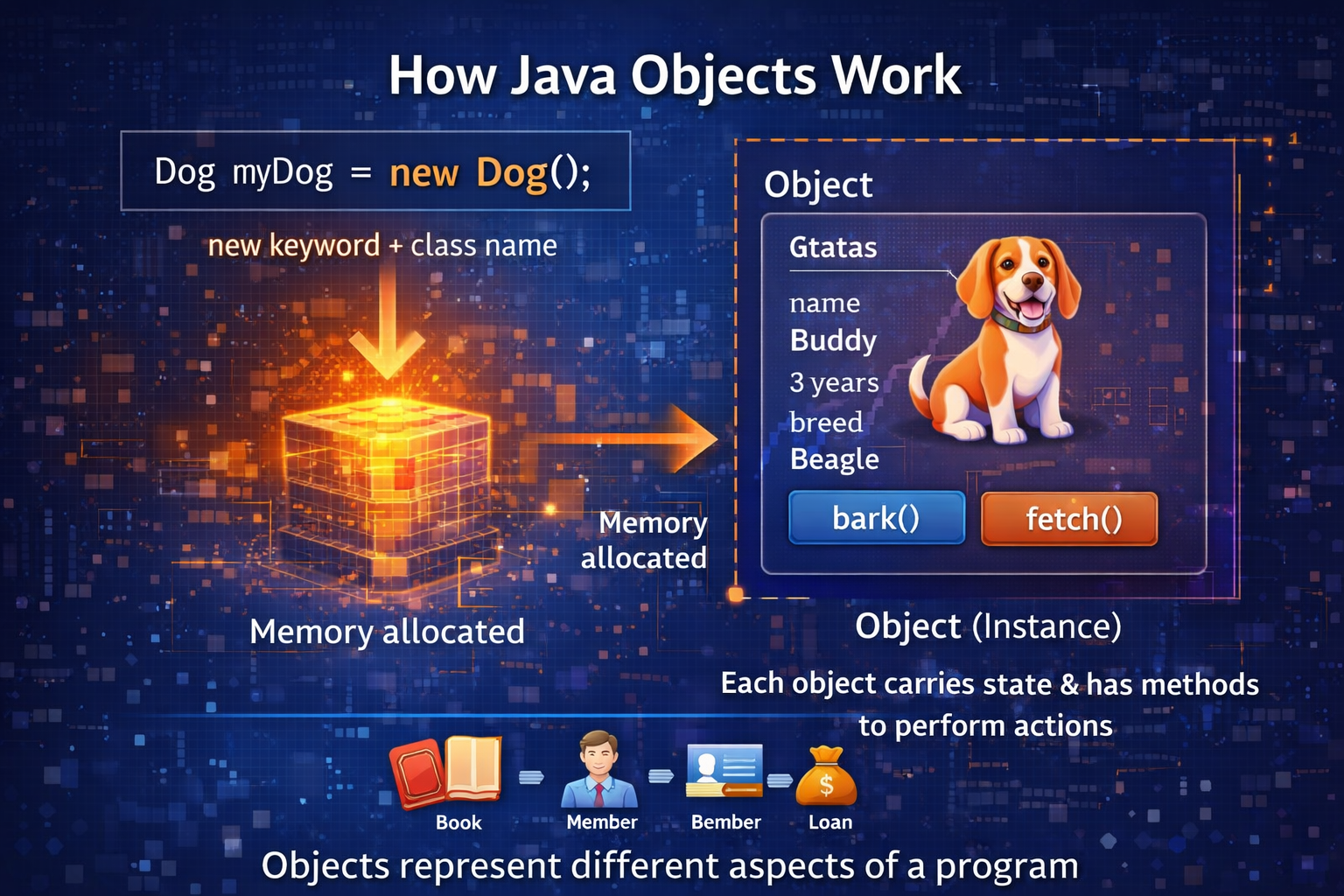
An object is formed in Java by using the new keyword with the name of the class. When a new instance of an object is created, the memory is allocated to hold the instance and its members. Each object can carry a state inside it and has methods (functions) that enable it to do things. For example, a dog object could have a function to bark or fetch a ball.
In order to model and organise data in a program, we need to be able to describe data using Java objects. They make the program more modular because each object can stand for something different in the system or for a different aspect of something. For example, a library automation program could have classes of Book, Member, and Loan, all of which may have their own properties and methods.
The Java.net Package: A Gateway for Network Programming
The Java.net package from Java, which is a collection of classes used for networking purposes. It provides the framework that applications use to communicate over the internet or through the networks. The module is a key service for data delivery programs that require, with some sense of reliability, the delivery of data across a network.
-
Low-Level Networking in java.net
Networking may include the exchange of data among computers coupled to the internet or a local area network (LAN). At the heart of networking, some sockets enable two devices to find each other. The Java.net namespace contains classes that allow developers to work with these sockets.
For example, protocols such as UDP (User Datagram Protocol) exist, which facilitate rapid and connectionless communications between devices. Using the java. net package, but programmers can utilise datagram-level networking via the DatagramPacket and DatagramSocket classes. Such tools allow for rapid communication—but not necessarily accurate data.
On the contrary, TCP (Transmission Control Protocol) represents a more trustworthy protocol that guarantees packets will be delivered in sequence without errors. UDP might be faster, but TCP ensures no packet is lost accidentally, and its use is wiser in many cases,s such as web browsing or emailing.
-
Networking in Java with an example in Java.net
When high-level networking tools hide the details of data transfer, low-level tools equip developers with the freedom to exert full control over data transfer. Useful when you are not interested in low-level details of wire communication (web servers, sockets, libraries), but you want to communicate with regular internet resources instead (websites, web APIs).
For example, the java.net package is used to work with web resources. A URL is a reference to a resource on the Internet, and Java has provided a class called URLConnection to help connect to the remote resource and read and write data.
A very important class in high-level networking is HttpURLConnection, which makes it easier to interact with web servers with the HTTP protocol. This class teaches you how to use the web to enquire a web server for something (like a web page), and instead of dealing directly with the data, without having to worry about the lower-level details of data transmission.
Java Objects vs. the java.net Package
Although specific to Java, the Java objects and java. net package in Java. While both are vital functions of Java programming, they have their own functions.
We have seen that objects in Java are instances of classes, and objects are anything that can perform some activity and can be initiated and destroyed. These are the building blocks we use to describe things (world or concepts in the world) in code. They promote structured and modular programming and are used to structure data and behaviour in Java.
The java.net Package: On the contrary, the java. The net package is not so much about making objects in the classical Java way. It is not; instead, it gives you classes and tools that allow you to manage network communication. The java. net provides an easy way to connect to remote servers, send requests and read responses over the internet, and manage network protocols like HTTP, TCP, and UDP.
Therefore, whereas Java objects serve to model data and functionality in an application, the Java. objects, the net package can be used to allow the objects to communicate over a network. These two ideas complement each other well in networked applications, where Java objects hold and manage data, and the Java. net code responsible for sending that data between machines.
How Java Objects and the java.net Package Work Together
Java objects and the java.net packages often go hand in hand in today’s applications. Although Java objects structure and model application data, a java.net package is used to make that data move over the network.
Consider, for example, that you’re building an online shop. You can create a Product object to hold details for an item, such as name, price, and description. You could, when users come to your site, create a jav. net package to access the net/http package, so you could make a web request to a server for the product details from the remote database, or post the product information to the server to save.
The union of Java objects as data representation and Java.net, for inter-system communication, provides a strong basis for the implementation of networked applications. By doing this, developers can develop a complex system that can have communication over the web and retain the same structure and organisation of Java objects.
Conclusion
Java objects and the java.net are the essence of a Java application, and they’re defined as blocks of code that combine data and functionality in a structured manner. They enable developers to model real-world entities, such as products, users, or vehicles, and to work with them in code.
On the other hand, the java.net package is a collection of classes used to provide access to common network facilities. When you are sending data over the network or when you are receiving the data from the network devices, or when you connect two devices, the involved devices are known as server and client devices, and for accepting a request and for establishing the connection between devices, we use the Java.net package can be used to do that.
Java objects and the java.net library to develop effective, network-capable applications that are better organised and interact effectively with the Internet. Combining them enables developers to construct an application that can both store and process its data, while also being able to communicate with external systems.